Tanks & Pumps · Story
Booster Pumps: Getting Tank Water Back to the House
A booster pump for a water storage tank pushes stored water to the house at usable pressure, usually with a pressure tank, and it stops whenever the power does.
By the Ranch House Water desk · Updated · 7 min read
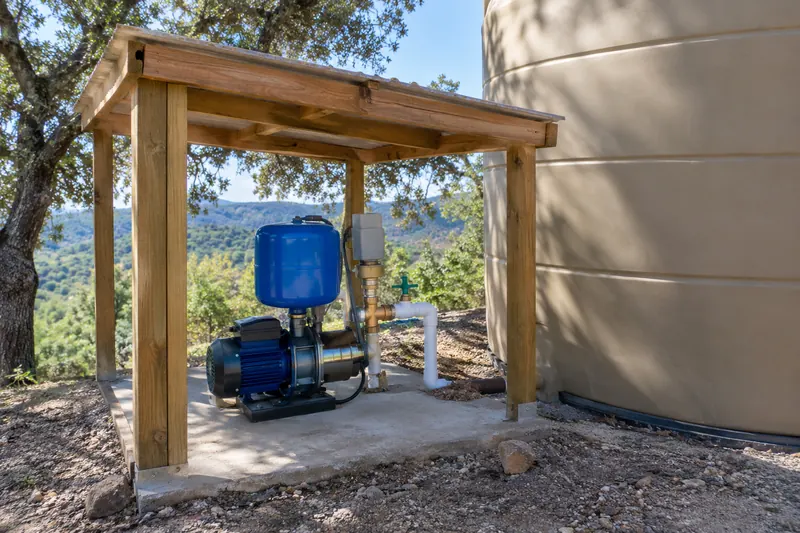
A booster pump for a water storage tank is the link between a tank on the hill and the taps in the house. Where a well fills storage slowly, or a water truck fills it now and then, the booster draws from the tank and pushes water into the home's pipes, usually charging a pressure tank so it does not start every time someone opens a faucet. In north San Luis Obispo County, where PG&E may cut power during fire weather and winter brings regular frost, that pump needs a plan for both.
How does a tank-to-house system work?
Water flows from the storage tank's outlet to the booster pump, which raises its pressure and sends it into the house line. A pressure tank on that line holds a cushion of pressurized water, and a pressure switch tells the pump when to start and stop. Valves on each side let a plumber isolate the pump or the tank for service without draining everything.
EPA's well page separates pumps into above-ground jet pumps, which pull water by suction, and submersibles lowered inside the casing (EPA). A booster sits downstream of storage rather than at the wellhead, yet its wearing parts are much the same. For those parts see the well pump and pressure tank; for the tank, see water storage tanks.
No official sizing or pressure figures for home boosters turned up in our research; those come from the makers' manuals and the installer, so keep both with the house records.
What wears out, and what can an owner check?
Signs worth writing down include pressure that swings, a pump that starts and stops rapidly, or a pump that runs and runs. Owners can safely do the watching: read the pressure gauge, listen to how often the pump cycles, note any change, and switch the pump's breaker off if it runs without stopping or the tank is empty.
Sediment is a slow cause: grit carried from a well can settle in both storage and pressure tanks until they need cleaning, state water officials note (State Water Board). Anything past observing, opening an electrical box, adjusting a pressure switch or rewiring, is work for a licensed professional.
| Task | Who |
|---|---|
| Read the gauge, note cycling, keep records | Homeowner |
| Switch the pump breaker off | Homeowner |
| Pressure switch, wiring, controls, transfer switch | Licensed electrician or pump contractor |
| Pump, pressure tank, valves and backflow devices | Licensed C-36 plumbing contractor |
| Pump inside the well itself | Licensed C-57 well contractor |
The state's C-36 plumbing class includes upkeep of regulating valves and backflow preventers, while C-57 holders drill and repair wells and the pumps in them (CSLB). Under the minor-work rule in force since January 1, 2026, any job of $1,000 or more, or any job that needs a building permit, requires a licensed contractor.
What happens to the water when the power goes out?
An electric booster stops, and the taps run only on the pressure stored in the tank and pipes. PG&E calls Public Safety Power Shutoffs when wind and dry brush raise fire risk, and says they can last several hours or several days (PG&E). Customers get a first notice 48 to 24 hours ahead and another 4 to 1 hours ahead, and the utility aims to bring power back within a day of the weather clearing (PG&E PSPS booklet). Its materials say nothing about private pumps, so the planning is yours.
When a notice comes, fill drinking water containers and anything else you need from the taps while the pump still runs. Our story on power shutoffs and wells has a longer checklist.
Can a generator run the booster pump?
Yes, with safe placement and a proper connection. CPSC and CDC put portable generators outdoors only, at least 20 feet from the house and clear of windows, doors and vents, exhaust aimed away. A garage, barn, shed, crawlspace, porch or carport is never acceptable, and opening doors will not clear the carbon monoxide (CPSC, CDC). Keep battery or battery-backup CO alarms inside. When one goes off, or someone feels sick, leave the house for fresh air first and call 911 from outdoors.
Hooking a generator into the pump circuit or the house wiring through a transfer switch is a job for a licensed electrician. CAL FIRE warns that an improper generator installation can put you or utility workers at risk of electrocution (CAL FIRE). More in generator safety in outages.
How do frost nights affect a booster pump?
Often enough to plan for. Over 1991-2020, Paso Robles' in-town weather station averaged 54.3 frost nights (32°F or colder) annually: 8.7 in November, 18.0 in December, 14.3 in January and 8.6 in February (NOAA). A pump, pressure tank and short runs of pipe sitting outside next to a tank are exposed on those nights. Insulate and shelter them as the maker allows; see frost nights and pipes.
- November8.7 nights
- December18.0 nights
- January14.3 nights
- February8.6 nights
Source: NOAA
If a pipe does freeze, the National Weather Service says to open the faucet and warm the pipe with a space heater, heating pad, hair dryer or hot cloths, and never to use an open flame (NWS). Leave anything touching the pump's wiring to an electrician.
What about fire season?
Plan the tank and pump around the fire rules. New homes must keep a set reserve for firefighting, and tanks may not be daisy-chained without the Fire Department's prior approval. CAL FIRE suggests owners consider pumps for pools or wells to add water during fires (CAL FIRE), and its evacuation checklist asks people not to leave sprinklers or water running, because that can lower critical water pressure (CAL FIRE). Follow evacuation orders from CAL FIRE and SLO County Fire when they come. More is in fire water storage.
Where to call
- Contractors State License Board — verify an electrician's license, or a C-36 or C-57 contractor, before work starts. License check
- PG&E Public Safety Power Shutoffs — sign up for outage alerts for your address. Their official page
- County Fire Marshal (SLO County Fire / CAL FIRE) — fire water and tank arrangements on your parcel. Their official page
- Emergencies — CO alarm, fire or injury: get outside to safety first, then call 911.
Common questions
Why does my booster pump turn on and off so quickly?
Rapid cycling can come from the pressure tank or the controls. Note how often it happens and have a licensed plumber or electrician check it; don't adjust the pressure switch inside its electrical box yourself.
Will my faucets work during a power shutoff?
Only briefly. An electric booster pump stops without power, leaving whatever pressure is stored in the pressure tank and pipes. Fill containers when PG&E sends its advance notice.
Can I plug the pump into a generator with an extension cord?
Connections to the pump circuit or house wiring belong to a licensed electrician, who can install a transfer switch. Whatever the setup, the generator stays outdoors at least 20 feet from the house and away from openings.
Should I shut the pump off when the tank runs low?
Switching the pump's breaker off is something an owner may do if the tank is empty or the pump runs nonstop. Then find out why the tank is low, and have a licensed pro look at the pump before restarting it if anything seems wrong.
Sources
- U.S. EPA — Learn About Private Water Wells — jet and submersible pumps
- State Water Board — A Guide for Private Domestic Well Owners — sediment in storage and pressure tanks
- PG&E — Public Safety Power Shutoffs — outage length and purpose
- PG&E — Your guide to Public Safety Power Shutoffs — notice timeline, restoration goal
- CPSC — winter storm carbon monoxide safety tips, 2026 — generator placement, CO alarms
- CDC — Carbon Monoxide Poisoning Basics — generator distance from windows, doors and vents
- CAL FIRE Ready for Wildfire — GO Evacuation steps — generator installation risk, leave sprinklers off
- CAL FIRE Ready for Wildfire — Hardening Your Home — pumps for pools or wells
- NOAA NCEI — 1991-2020 normals, Paso Robles — freezing nights
- National Weather Service — Essential Tasks After it Warms Up — thawing pipes without flame
- CSLB — Licensing Classifications — C-36 and C-57 scope