In the House · Story
Softeners and Filters on a Well: Test First, Then Treat
A water softener for well water removes hardness and some iron, not arsenic or nitrate; get an accredited lab test first, match the unit to the result, and retest after it is installed.
By the Ranch House Water desk · Updated · 7 min read
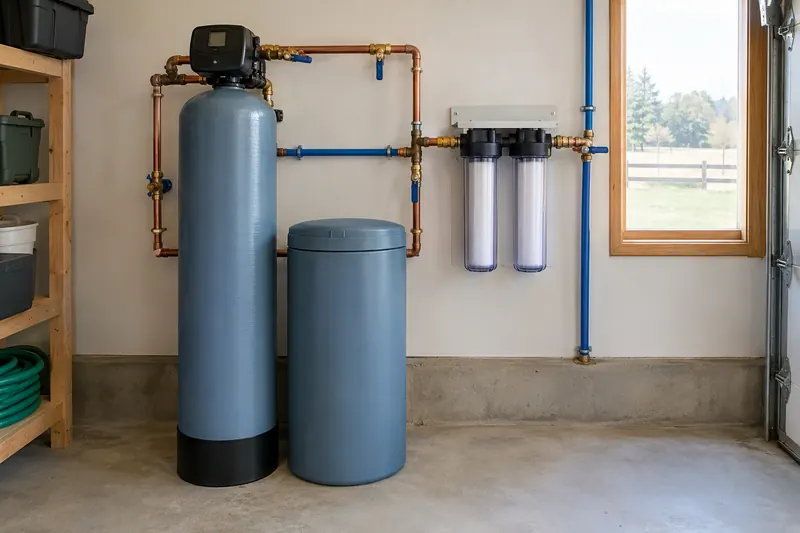
A softener answers one question, hardness, and a well in north San Luis Obispo County can raise several others. Of roughly 1,058 wells checked by the free Central Coast testing program from late 2018 on, about 33 percent failed at least one drinking water standard, according to the Central Coast Regional Water Board. Nitrate and hexavalent chromium topped the list, and a softener treats neither one.
What should be tested before buying a softener?
Start with a lab test, not a store kit. SLO County Environmental Health Services recommends an initial test for primary drinking water standards and total coliform bacteria. For yearly checks, the State Water Board's well owner publication names bacteria, nitrate and electrical conductivity; for metals such as arsenic, iron and manganese, it suggests a package at intervals of 5 to 10 years, sooner if the water changes.
Pick a laboratory on the state's ELAP accreditation list. The same state publication warns that home test kits may not give a numerical concentration. A kit can help you track hardness, iron or pH between lab tests, but arsenic, nitrate, boron and uranium need a lab. Our story on testing your well water walks through the steps, and free well testing on the Central Coast sets out who can sign up.
What does a water softener actually remove?
A softener's main job is calcium and magnesium, the minerals behind white spots on dishes and crust around fixtures. The State Water Board lists a softener as the treatment for that symptom, and also lists softeners alongside iron filters for orange or reddish water caused by iron. For brown or black stains from manganese and iron, it lists reverse osmosis, a softener or ion exchange, and oxidizing filters.
Local supplies show why owners ask. On the U.S. Geological Survey scale, 60 mg/L is the ceiling for soft water, 120 mg/L for moderately hard and 180 mg/L for hard; anything higher counts as very hard. The San Miguel Community Services District reported 317 ppm in its 2025 report, while Atascadero Mutual Water Company put its 2025 average at 20.2 grains per gallon. More local figures sit in hard water numbers in north county.
- Top of "soft"60 mg/L
- Top of "moderately hard"120 mg/L
- Top of "hard"180 mg/L
- San Miguel CSD average317 mg/L
Source: USGS; San Miguel CSD
What a softener will not take out
A softener does not remove nitrate or arsenic. According to the State Water Board's nitrate summary, boiling, softening and filtration leave nitrate where it was; distillation, reverse osmosis, ion exchange and electrodialysis can lower it. The state ceiling is 45 mg/L when a lab reports nitrate as nitrate, which equals 10 mg/L when reported as nitrogen. Babies younger than six months are most at risk, and the Board says an infant showing symptoms needs medical care right away.
For arsenic, with a limit of 10 µg/L, the Board's arsenic summary lists activated alumina, anion exchange, reverse osmosis and similar processes. Boron carries no legal limit but triggers state notification at 1 mg/L; the boron summary names distillation, ion exchange and reverse osmosis and says dissolved boron is difficult to remove. Our stories on arsenic, nitrate and boron go further.
| What you see or what the lab finds | Likely cause | Treatments the state lists |
|---|---|---|
| White spots, crust on fixtures | Calcium and magnesium | Water softener |
| Orange or reddish brown water | Iron | Softeners and iron filters |
| Brown or black stains | Manganese and/or iron | Reverse osmosis, softener or ion exchange, oxidizing filters |
| Rotten-egg smell | Hydrogen sulfide | Oxidation, activated carbon, shock chlorination, ion exchange, ozone |
| Nitrate over the limit | Nitrate | Distillation, reverse osmosis, ion exchange, electrodialysis (not softening) |
Is reverse osmosis worth it for the drinking tap?
It can be, when a lab result shows a contaminant that reverse osmosis is listed for, such as arsenic, nitrate or boron. Buy a unit tested for that contaminant. California runs a Water Treatment Device Registration Program for devices sold with health claims, and its database can be searched by contaminant and by system type. We did not find official California advice on point-of-use units for arsenic specifically, so match the unit to the registration listing and your test.
Sediment, iron and the rotten-egg smell
Sand and silt are a plumbing problem before they are a health one. The state's well owner publication notes that sediment can collect in pressure tanks and storage tanks and need maintenance; a sediment filter ahead of other equipment is a common way to protect it. The State Water Board's screening levels are 0.3 mg/L for iron and 0.05 mg/L for manganese.
A rotten-egg smell at the taps usually means hydrogen sulfide, which Penn State Extension says most people can smell well below 0.5 mg/L. If it is only in the hot water, the water heater's anode may be the source. More is in rotten-egg smell in water. If the odor hangs in a room rather than coming from running water, it may be gas: leave the house first, then see propane smell on a rural property.
How do you know the treatment is working?
Retest after the equipment is installed, through an accredited lab, for the same contaminant that started the search. Sample the treated water the way the lab instructs. Keep results with the well records and test again on the schedule above, since a well's water can change. Work on the pump, pressure tank or well itself belongs to a licensed C-57 contractor; see the well pump and pressure tank.
Where to call
- State Water Board ELAP — search the map of accredited laboratories. ELAP lab search
- State Water Board device registration — look up treatment units registered for a contaminant. Residential water treatment devices
- SLO County Environmental Health Services — what the county recommends that well owners test. Private well owner resources
- Contractors State License Board — check a plumber (C-36) or well contractor (C-57). License Check
Common questions
Does a water softener remove arsenic?
No. The State Water Board's arsenic treatment list names activated alumina, anion exchange and reverse osmosis, not a household softener. Test through an accredited lab and choose a unit registered for arsenic.
Will a softener fix high nitrate?
No. The state's nitrate summary says softening does not reduce nitrate. Distillation, reverse osmosis, ion exchange and electrodialysis can.
Can I use a store test kit instead of a lab?
For hardness, iron or pH between lab tests, a kit can help. The state warns that kits may not give a numerical concentration, so health contaminants need an accredited lab.
Should I retest after installing treatment?
Yes. Test the treated water through an accredited lab for the contaminant you were treating, then keep testing on a regular schedule.
Sources
- Central Coast Water Board — Drinking Water Well Testing Program summary — 1,058 wells, 33 percent
- State Water Board — A Guide for Private Domestic Well Owners — tests, kits, symptoms and treatments
- SLO County — Well Owner's Checklist — initial test
- State Water Board — GAMA nitrate sheet — limit, infants, treatment
- State Water Board — GAMA arsenic sheet — limit and treatment types
- State Water Board — GAMA boron sheet — boron treatment
- State Water Board — Residential Water Treatment Devices — device registration
- USGS — Hardness of Water — hardness scale
- San Miguel CSD — 2025 Consumer Confidence Report — 317 ppm hardness
- Penn State Extension — Hydrogen Sulfide in Water Wells — odor threshold