Wells · Story
How the Well Pump and Pressure Tank Share the Work
A well pump and pressure tank work as a pair: the pump fills the tank, the tank holds water under pressure, and a switch decides when the pump runs.
By the Ranch House Water desk · Updated · 6 min read
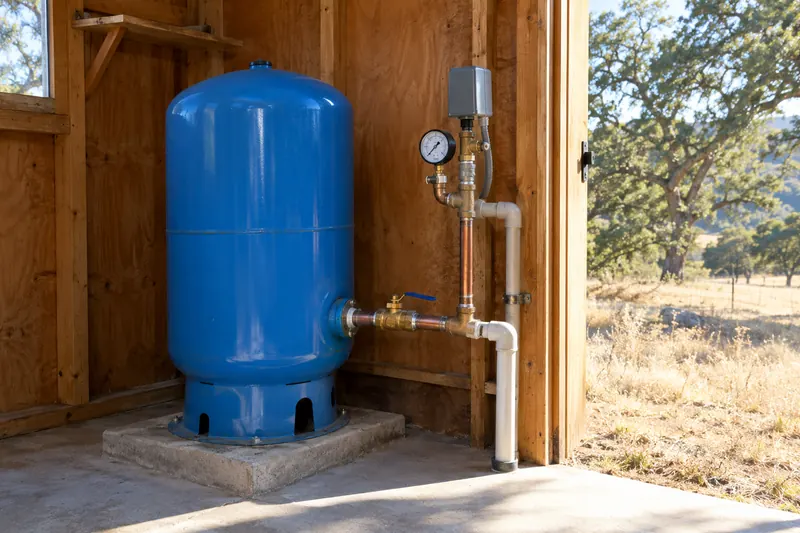
On most ranch properties around Paso Robles, water reaches the house through three parts that rarely get a second look until one fails: a pump down in the well, a pressure switch that turns it on and off, and a pressure tank that stores a working reserve. The EPA notes that submersible pumps are the usual choice for deep private wells, with the pumping unit set inside the well casing.
What does each part do?
The pump lifts water; the tank stores some of it under pressure; the switch reads that pressure and starts or stops the pump. A submersible pump hangs in the well below the water line and pushes water up the drop pipe to the surface. A jet pump, by contrast, sits above ground and pulls water up by suction, and the EPA describes it as the common type for shallow wells, those 25 feet deep or less.
At the top of the casing, the well cap keeps out insects, rodents and runoff. The EPA notes that caps include a vent to control pressure while the pump runs, which is one more reason never to seal or bury the wellhead.
How do the pump, switch and tank work together?
When someone opens a tap, water first comes out of the pressure tank, so the pump does not have to start for a glass of water. As the tank empties, pressure drops until the switch closes and starts the pump. The pump then refills the tank and supplies the house until pressure rises to the switch's upper setting, and the switch shuts the pump down.
Inside most modern tanks, a cushion of air pushes on the water. That air charge is what lets the tank hand out water between pump starts. The right size of tank and the right switch settings depend on the pump and the household, and they are set by the pump contractor; we have not found an official table for them, so this story gives none.
Why does the pump keep clicking on and off?
Rapid starting and stopping, often called short cycling, usually means the system has lost its stored reserve, so the pump runs for every small draw. A tank that has lost its air cushion, a leak on the line, or a fault in the switch can each produce it. Each start wears on the motor and the switch contacts, so short cycling is worth reporting promptly rather than living with.
What an owner can safely do is watch and write down. Note how many seconds the pump runs and rests while one tap is open, what the gauge reads when the pump starts and stops, and whether water shows at the tank or along the line. Hand those notes to the contractor. Sediment can also settle in pressure tanks and storage tanks, the State Water Board's GAMA booklet points out, and that is another thing a contractor can check.
Which checks belong to the owner?
Reading the gauge, listening to the pump, looking for leaks, keeping the area around the tank dry and clear, and switching the breaker off when something is wrong: that is the owner's share. Everything inside the electrical boxes, everything down the well, and any change to the tank's air charge or the switch settings is not.
San Luis Obispo County's checklist for well owners says pump installation and servicing call for licensed or certified people, every time. The Contractors State License Board's C-57 Well Drilling classification covers installing and repairing water wells and pumps, and the board's License Check page shows whether a license is active. Our brief on hiring a well or pump contractor covers the rest.
| Task | Owner | Licensed well or pump contractor |
|---|---|---|
| Read the pressure gauge and note pump run times | Yes | Also |
| Keep the wellhead and tank area clear and dry | Yes | |
| Switch the pump breaker off when something is wrong | Yes | |
| Open the pressure switch or change its settings | No | Yes |
| Check or recharge the tank's air cushion | No | Yes |
| Pull, replace or rewire the pump | No | Yes |
| Disinfect the well after pump work | No | Yes |
Does a well need disinfecting after pump work?
Yes. The state's well standards say a domestic well must be disinfected after construction or repair, or when work is done on the pump, before it goes back into service. Pulling a pump lowers tools, pipe and hands into the casing, and bacteria can ride along. Our brief on well disinfection explains the timing of the follow-up test.
What happens to the pump in a power outage or after a disaster?
With no electricity the pump cannot run, so the house has only what is left in the pressure tank and any storage tank. Our story on power shutoffs and wells deals with planning for that. After a flood, fire or other disaster, the CDC advises having the wiring checked by a qualified electrician or a well or pump contractor before the well's power is turned back on, and that well work after a disaster is for a well or pump contractor.
Homes that feed the house from a storage tank through a second pump have one more part in the chain; see booster pumps and the wider picture in living on a private well.
Where to call
- A licensed C-57 well or pump contractor — short cycling, low pressure, tank air charge, pump replacement and post-repair disinfection. CSLB License Check
- County Environmental Health, Well Program — county resources for private well owners. Well Program
- A licensed electrician — checking well wiring after a fire, flood or other disaster, as the CDC advises. CDC well guidance
Common questions
Can I adjust the pressure switch myself?
No. The switch sits in a live electrical box, and changing its settings can push the pump and tank outside what they were matched for. Note the gauge readings and leave adjustments to a licensed pump contractor.
Why is there only a little water when the power is out?
The pump stops without power, so the house can use only the water still held in the pressure tank and any storage tank. Once those empty, the taps stop.
What does the vent on the well cap do?
The EPA says the vent controls pressure inside the casing while the pump runs. Keep it clear and screened, and keep the cap above ground.
Is a jet pump used on deep wells here?
The EPA describes jet pumps as the usual choice for shallow wells of 25 feet or less, and submersible pumps for deep wells. Ask the contractor which type your well has; the well log shows its depth.
Sources
- U.S. EPA — Learn About Private Water Wells — jet and submersible pumps, 25-foot shallow-well line, well cap vent
- DWR — Combined Well Standards, Section 11 (archived copy) — disinfection after pump work
- County of San Luis Obispo — Well Owner's Checklist (archived copy) — licensed pump installers
- Contractors State License Board — C-57 Well Drilling Contractor — scope covers wells and pumps
- CDC — How to Disinfect Wells After an Emergency — wiring check before power returns; disaster work for contractors
- State Water Board GAMA — A Guide for Private Domestic Well Owners (June 2025) — sediment in pressure and storage tanks