Tanks & Pumps · Story
The Water Tank on the Hill: What Rural Owners Should Know
A water storage tank on a rural home holds drinking water, fire water or both, and it stays safe only if its openings are screened, its lids stay shut and nobody climbs inside.
By the Ranch House Water desk · Updated · 7 min read
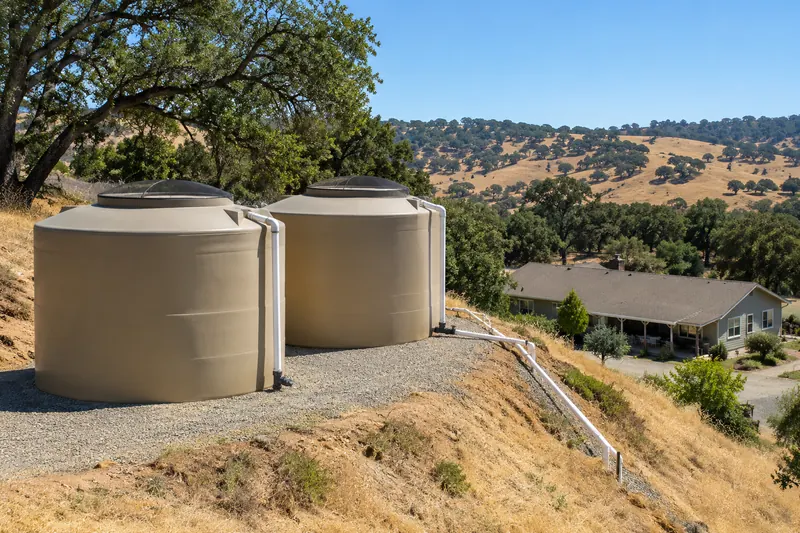
A water storage tank on a rural home in north San Luis Obispo County usually does two jobs at once: it buffers a slow well or holds hauled water for the house, and it keeps a reserve for firefighters. San Luis Obispo County Fire says most new residential projects end up with at least a 5,000-gallon tank, because its 2,500-gallon minimum fire reserve is added to normal household use. How that tank is set up, screened and plumbed decides whether the water in it stays fit to drink.
Why do so many rural homes have a storage tank?
Because a well, a water truck and a fire engine all work better with water waiting. A low-yield well can fill a tank slowly around the clock while the house draws from storage at a faster rate; yield is explained in when a well runs low. Homes that rely on delivered water need somewhere to put it, the subject of hauled water for rural homes. And on parcels in the State Responsibility Area, where SLO County Fire applies the state fire safe rules, new construction must have water set aside for wildfire.
Water in a tank has to be pushed back to the house, usually by a booster pump and a pressure tank, which our story on booster pumps covers.
How much fire water does the county require?
SLO County Fire's Standard 1 sets a minimum of 2,500 gallons of dedicated fire water for a residence, citing NFPA 1142, and says larger homes of 5,000 square feet or more need the amount calculated by a fire protection engineer or a C-16 contractor. It adds that "most residential projects will require a minimum of a 5,000 gallon water storage tank" once household use is counted (Standard 1).
The county does not require a separate fire tank, only the dedicated amount. State rules likewise allow fire and household water to share storage unless a local rule or fire agency says otherwise (SRA Fire Safe Regulations). What the county does forbid is linking tanks together: "daisy chaining" is strictly prohibited without prior Fire Department approval, and approved multi-tank systems need valves chained and locked open and one common manifold. The details of fire connections are in our story on fire water storage.
- Load size that requires a licensed water hauler250 gallons
- Minimum dedicated fire water for a home2,500 gallons
- Typical tank size for a new residential project5,000 gallons
Source: California Department of Public Health; SLO County Fire
Standard 1 still refers to the 2022 California Fire Code, so ask the Fire Marshal's office whether a newer edition applies before buying a tank.
What keeps tank water clean?
Closed lids and screened openings. EPA's guidance on storage tank vents, drains and overflows is written for public water systems, but its logic fits a ranch tank: every opening must keep out birds, bats, other animals, insects, rain and windblown dirt (EPA).
| Opening | EPA practice |
|---|---|
| Vents | Screen with 24-mesh, non-corrodible screen |
| Overflow and drain lines | 24-mesh screen, or a sealed flapper or duckbill valve |
| Overflow outlet height | End 12 to 24 inches above ground, onto a splash plate or rocks |
| Overflow and drain connections | Never tied directly to a sewer or storm drain |
| Hatches and lids | Kept closed against animals, insects and rain |
Sediment is the other slow problem. The State Water Board's well owner booklet notes that sediment from a well can settle in storage and pressure tanks and need cleaning out (State Water Board). No official cleaning interval for private tanks was found; our brief on tank care and cleaning covers what owners can watch for. For tank material, look for a tank certified for drinking water use, such as one listed under NSF/ANSI/CAN 61; we found no California rule that requires it for a private home, so treat it as sound advice rather than law.
Is hauled water safe to put in a home tank?
It can be, if it comes from a licensed hauler. California requires anyone hauling drinking water in containers of 250 gallons or more to hold a Water Hauler's License from the California Department of Public Health's Food and Drug Branch. The license is renewed every year, and renewal requires current coliform bacteria results from the last 30 days for each truck (CDPH). Ask to see the license before the first load.
Whether a new home may rely on hauled water as its permanent supply is a county question we could not confirm. Ask County Environmental Health Services and Planning & Building before you plan around it.
Why does a backflow preventer matter?
Because a tank, a hose and a well can all push water the wrong way. When a storage tank, a fire connection, an irrigation line or a livestock trough is tied into the same plumbing as the house, a drop in pressure can pull dirty water back toward the drinking supply. A backflow preventer is the device that stops that reverse flow. California's C-36 plumbing license covers installing and maintaining backflow preventers (CSLB), and the county's well checklist warns owners not to let back-siphonage happen, for example by keeping hose ends out of chemical tanks (county checklist, archived copy).
Who should go inside a tank?
No homeowner. OSHA lists tanks among confined spaces: limited ways in and out, not made for anyone to stay in, and able to hold a hazardous atmosphere (OSHA, archived copy). Cleaning or repair that needs entry is work for professionals equipped for confined spaces. The same rule holds, with even more force, for septic tanks; see septic tanks are confined spaces.
Where to call
- County Fire Marshal (SLO County Fire and CAL FIRE) — dedicated fire water, tank linking rules and fire connections for your project. Their official page
- SLO County Health Agency, Environmental Health — private water supplies, hauled water questions and disinfection guidance. Their official page
- California Department of Public Health, Food and Drug Branch — check a water hauler's license. Water hauler licensing
- Contractors State License Board — confirm a C-36 plumbing license for tank, valve and backflow work. License check
Common questions
Does fire water have to sit in its own tank?
No. SLO County Fire requires a dedicated fire water amount, not a dedicated tank. Most homes meet it with a single tank of at least 5,000 gallons that also serves the house. Confirm your project's number with the Fire Marshal.
Can I connect two smaller tanks instead of buying one big one?
Not without approval. SLO County Fire strictly prohibits daisy chaining tanks unless the Fire Department approves it in advance, and approved setups need valves chained and locked open on a common manifold.
How often should a household water tank be cleaned?
No official interval for private tanks was found. Watch for sediment, check screens and lids, and follow County Environmental Health guidance on disinfection. Cleaning that needs entry is for professionals.
What size screen goes on a tank vent?
EPA's practice for drinking water tanks is a 24-mesh, non-corrodible screen on every vent, with the same mesh or a sealed flapper or duckbill valve on overflow and drain lines.
Is the water in my tank safe after a wildfire or flood?
San Luis Obispo County advises drinking bottled water after a disaster until you are certain your supply is free of contaminants. Have it tested by an accredited lab before going back to it.
Sources
- SLO County Fire / CAL FIRE SLO — Standard 1, Water Supply — dedicated fire water, typical tank size, daisy chaining
- SLO County Fire / CAL FIRE SLO — SRA Fire Safe Regulations 2023 — combined storage allowed
- CAL FIRE SLO — Fire Department Connection Specs, July 2025 — fire connection outlet height
- U.S. EPA — Sanitary Protection of Storage Tanks: Vents, Drains and Overflows — screens, overflow height, no sewer connection
- California Department of Public Health — Water Hauler License Procedures — 250-gallon threshold, annual renewal, coliform tests
- State Water Board — A Guide for Private Domestic Well Owners — sediment in storage tanks
- OSHA — Confined Spaces overview (archived copy) — tanks as confined spaces
- CSLB — C-36 Plumbing Contractor — backflow preventer work
- County of San Luis Obispo — Disaster Preparedness and Response (archived copy) — bottled water after a disaster