Wells · Story
When a Well Runs Low: Signs, First Steps and Reporting
When a well is running dry around Paso Robles, switch the pump breaker off, use stored or bottled water, have a C-57 contractor measure the well, and report it to the state.
By the Ranch House Water desk · Updated · 6 min read
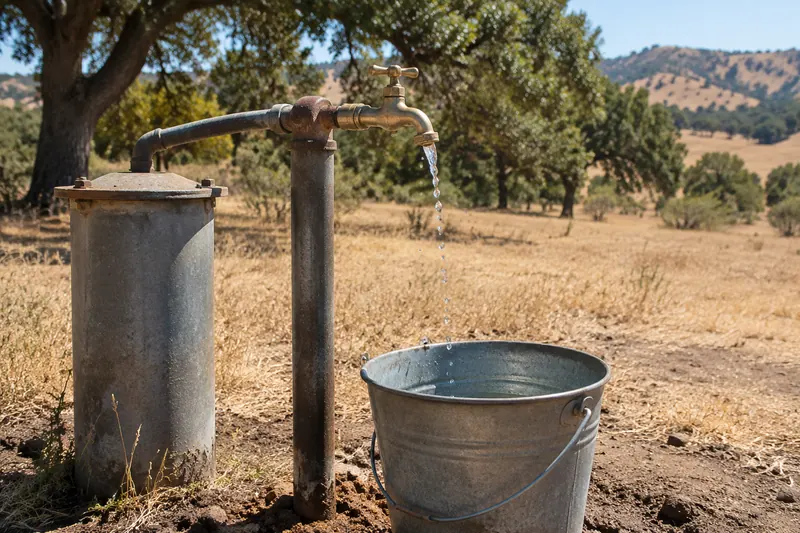
When a well goes dry in north county, the basin's own records point to groundwater that has been dropping for decades, not to one dry winter. The latest annual report for the Paso Robles Area Subbasin, dated March 26, 2026, records dry and replaced wells during water year 2025 and calls them a direct result of declining water levels, and many of its monitoring records show that decline running back to the late 1990s.
How do you know a well is running low?
The first hints are usually small: pressure that sags during long showers or garden watering, a pump that runs longer than it used to, air spitting from the taps, or water that turns cloudy or gritty after heavy use. None of these proves the well is failing; a worn pump, a leak or a pressure tank problem can look the same. What separates them is a measurement, and a licensed well or pump contractor can measure the water level in the well and compare it with the driller's log.
Summer is when these signs show up most. The in-town NOAA station in Paso Robles logs roughly 21 days of 100°F heat or more in an average year, and irrigation, livestock water and household use all peak together.
What should you do first?
If the taps sputter air or go dry, switch the pump breaker off so the pump does not keep running without water, and call a C-57 well or pump contractor. Then sort out drinking water. San Luis Obispo County's disaster advice is that bottled water is the safer drink while there is any doubt about the supply, and the same caution makes sense for a failing well until a lab result says the water is fine.
Water for washing and flushing can come from a storage tank or a hauler. Anyone hauling drinking water in loads of 250 gallons or more must hold a license from the California Department of Public Health; our brief on hauled water for rural homes and the story on water storage tanks cover the practical side.
How many wells have gone dry around Paso Robles?
The state's dry-well reporting system lists 440 reports for San Luis Obispo County. A count of DWR's public dataset finds 363 of them from people who gave Paso Robles, Templeton, San Miguel, Creston or Shandon as their city: 238 from Paso Robles, 79 from Templeton, 25 from San Miguel, 19 from Creston and 2 from Shandon. Reports are voluntary, and the city is a mailing address rather than the well's exact place in the basin, so the real number of dry wells could be higher.
- Paso Robles238 reports
- Templeton79 reports
- San Miguel25 reports
- Creston19 reports
- Shandon2 reports
Why are levels still falling when the county is not in drought?
Because the basin's problem is long-term pumping, not the weather of a single year. The U.S. Drought Monitor map for October 27, 2026 shows San Luis Obispo County 100% free of drought, yet the state classes the Paso Robles Area Subbasin as critically overdrafted. In water year 2025, 3 of the 22 representative monitoring wells sat below the plan's minimum threshold.
Set side by side, the two key numbers are nearly equal: 61,400 acre-feet pumped in water year 2025, and a sustainable yield of 61,100 acre-feet a year. Vineyards and other irrigated crops took about 91% of what was pumped. The same report cautions that the drop from earlier years came mostly from a new way of estimating farm water use, not from a real cut of about 15,000 acre-feet. Back in 2020, State Water Board staff warned that at the plan's first proposed thresholds, 123 domestic wells studied, about 17% of those analyzed, could be affected or go dry. Our stories on the Paso Robles groundwater basin and drought on a well go deeper.
How do you report a dry well?
Use DWR's Dry Well Reporting System, which is meant for people with private, self-managed wells. Filing there does not count as asking for local, state or federal aid, the site explains, and that everything except the owner's name, contact details and address becomes public. Reporting still matters: the counts above come from those reports, and they are part of how the shortage is seen. Our brief on reporting a dry well walks through the form.
Is there help with a replacement well?
Sometimes. County Environmental Health offers a possible fee waiver on the construction permit when a dry well is being replaced in one of the areas the county lists as hit hard by low water. Ask the Well Program whether your parcel qualifies before the driller files. We did not find any county program that delivers free emergency water to dry-well households, so check with the county directly.
Deepening or replacing a well needs a county permit and a C-57 driller, the same as any new bore; see drilling a new well and household wells and basin rules.
Where to call
- C-57 licensed well and pump contractors — measuring the water level, checking the pump, and options to lower the pump, deepen or replace. CSLB License Check
- DWR Dry Well Reporting System — filing a report on a private well that has gone dry. Report a dry well
- County Environmental Health, Well Program — permits for a replacement bore, and whether the fee can be waived. Water Well Construction Permitting
- ReadySLO — current county emergency information. ReadySLO
Common questions
Does reporting a dry well get me state assistance?
No. DWR treats the report as data only. Applying for aid is a separate step through other programs.
Is my name public if I report a dry well?
DWR says the owner's name, contact details and address are kept private, and the rest of the report is visible to the public.
Can I keep running the pump until water comes back?
Switch the pump breaker off if the taps sputter air or go dry, and have a licensed well or pump contractor check the well before restarting it.
Can a dry-well replacement skip the permit fee?
Possibly, if the county counts your area as low water impacted. Ask the Well Program about the waiver before drilling starts.
Is the county in drought right now?
Not on the October 27, 2026 U.S. Drought Monitor map, which shows the county 100% drought-free. Basin levels can still fall because pumping, not one dry year, drives the decline.
Sources
- Paso Robles Subbasin Water Year 2025 Annual Report (March 26, 2026) — dry wells in WY2025, decline since late 1990s, 3 of 22 wells, pumping and yield, method caveat
- DWR — Dry Well Reporting System Data — county and town counts (our tally of the public dataset)
- DWR — Dry Well Reporting System — who may report, not an assistance application, what is public
- County of San Luis Obispo — Water Well Construction Permitting (archived copy) — dry-well fee waiver
- County of San Luis Obispo — Disaster Preparedness and Response Information (archived copy) — bottled water until supply is known safe
- CDPH Food and Drug Branch — Water — licensed haulers for loads of 250 gallons or more
- U.S. Drought Monitor — San Luis Obispo County statistics, map of October 27, 2026 — county drought-free
- State Water Board — comments on the Paso Robles Area GSP (December 8, 2020) — 123 domestic wells, 17%, at proposed thresholds
- NOAA NCEI — 1991-2020 normals, Paso Robles station — about 21 days a year at or above 100°F