Fire & Drought · Story
When the Power Goes Out, So Does the Well
A power outage stops an electric well pump, so a rural home on a private well has only its stored water until power returns or a safely installed generator takes over.
By the Ranch House Water desk · Updated · 6 min read
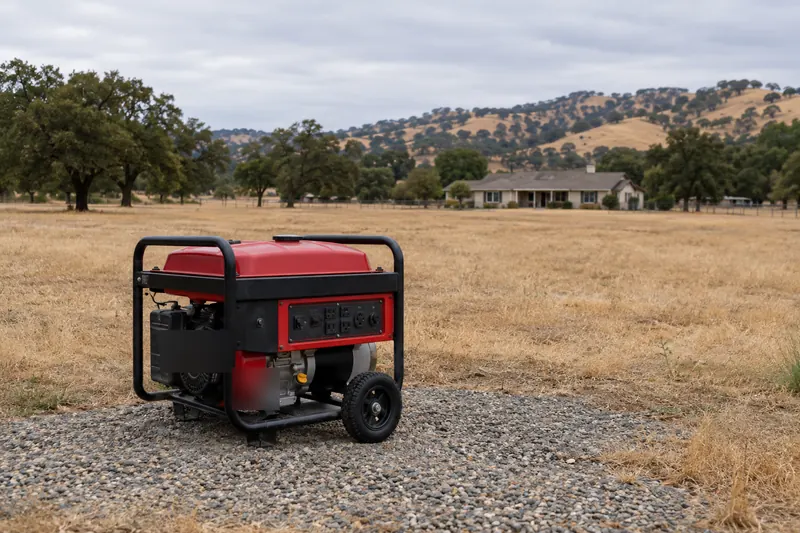
For a house in town, a power outage means dark rooms; for a ranch house on a private well, it also means the taps go quiet once the stored water runs out. Around Paso Robles, the outages most likely to last are PG&E's Public Safety Power Shutoffs, which come on dry, windy days and, in PG&E's words, may last several hours or several days.
What is a Public Safety Power Shutoff?
It is a planned outage PG&E uses when high winds and dry vegetation make it likely that damaged lines could start a fire. The utility's PSPS page describes it as a temporary outage to keep people safe, and says it may last several hours or several days depending on the weather.
PG&E's stated goal is to restore power within 24 hours after the severe weather has passed. That is a goal, not a promise, and the clock starts only once the wind has dropped and crews have checked the lines.
How much warning does PG&E give?
Usually a day or two. PG&E's PSPS customer booklet lays out a series of notices, and water and wastewater systems get priority notice 48 to 72 hours ahead. The booklet does not mention private wells, so a household well owner should plan as an ordinary customer. Alerts can be set up at pge.com/myalerts.
| When | Notice |
|---|---|
| 48 to 24 hours before power is turned off | first customer notice |
| 4 to 1 hours before | second notice |
| When power is turned off | shutoff notice |
| After the severe weather has passed | weather update |
| Daily | updates until power is restored |
Why does the water stop?
Because nearly every part of a rural water system runs on electricity. A submersible pump down the well, a jet pump on a shallow well, and the booster pump that pushes water from a storage tank to the house all need power. When it goes, the pressure tank can still deliver what it holds, and then the taps slow and stop.
The details depend on your setup. How the parts fit together is laid out in the well pump and pressure tank, and the story on booster pumps covers homes that draw from a storage tank. A tank uphill of the house may still give some flow by gravity, but at much lower pressure than you are used to.
What water should be set aside before a shutoff?
Enough drinking and cooking water for everyone in the house until power is back, stored in clean containers. San Luis Obispo County's disaster information page says that after a disaster the safest choice is bottled water until you know your supply is free of contaminants.
When a first PG&E notice arrives, it is sensible to fill containers, run the dishwasher and laundry, and top up any storage tank while the pump still has power. Do not leave sprinklers running when a fire is near; CAL FIRE warns that it lowers the pressure firefighters need, as our story on defensible space and water explains.
Can a generator run the well pump safely?
Yes, if it is placed and connected correctly, and both of those matter. The CPSC wants a portable unit set up in the open, 20 feet or more from the house; garages, basements, crawlspaces, sheds, porches and carports are all off limits. The CDC adds that it should be more than 20 feet from any windows, doors and vents. Aim the exhaust away from every building people go into, a barn or pump house included.
Tying a generator into the well pump circuit or the house panel is licensed electrician's work, normally done with a transfer switch. CAL FIRE notes that a poorly installed generator can put you or utility line workers at risk of electrocution. A homeowner's part is limited to switching the pump breaker off or on. The full set of rules is in generator safety in outages.
Does a ranch house need a carbon monoxide device?
Most do. California's Health and Safety Code §17926 requires a CO device listed by the State Fire Marshal in any home that burns fuel in a heater or appliance, has a fireplace, or has an attached garage. Most ranch houses with propane qualify. CPSC recommends units that run on batteries or carry a battery backup, placed on every floor and just outside each sleeping area, so they still work while the grid is down. If one sounds, go outside right away and then call 911.
What should happen when the power comes back?
After an ordinary shutoff, most systems simply restart. After a fire, flood or other damage near the well, the CDC says a qualified electrician, well contractor or pump contractor should check the wiring before power is turned back on for the well, and that well work after a disaster belongs to a well or pump contractor. Do not go down into a well pit, where gases can build up. If the water may be contaminated, see our brief on well disinfection.
Where to call
- PG&E — shutoff maps, alerts and restoration updates. Public Safety Power Shutoffs
- ReadySLO — current county emergency information. ReadySLO
- CSLB — look up an electrician's or a C-57 well contractor's license before hiring. License Check
- U.S. Consumer Product Safety Commission — generator and carbon monoxide safety. CO Information Center
Common questions
Will my well work during a PG&E shutoff?
Not on its own if the pump is electric, which nearly all are. You will have the water in your pressure tank and any storage, and gravity flow if a tank sits above the house.
Does PG&E give well owners extra warning?
PG&E's booklet gives water and wastewater systems notice 48 to 72 hours ahead, but it does not mention private wells. Household well owners get the regular customer notices, the first 48 to 24 hours before a shutoff.
Can I plug my well pump into a portable generator myself?
Hooking a generator to a well pump or house wiring is work for a licensed electrician, usually through a transfer switch. CAL FIRE warns that poor installation risks electrocution for you or line workers.
How far from the house should the generator be?
Twenty feet or more, in the open, and clear of windows, doors and vents, per CPSC and CDC. A garage, shed, porch or crawlspace is never safe, even with the doors open.
Should I have the well checked after the power returns?
After an ordinary shutoff, usually not. After a fire or flood near the well, CDC says a qualified electrician or well or pump contractor should check the wiring before power goes back on for the well.
Sources
- PG&E — Public Safety Power Shutoffs (archived copy, Oct. 22, 2026) — what a PSPS is; several hours or days
- PG&E — Your guide to Public Safety Power Shutoffs (archived copy) — notice timeline, 24-hour restoration goal, priority notice for water systems
- CPSC — generator and CO safety tips, 2026 — 20 feet, no enclosed spaces, alarms on each level
- CDC — Carbon Monoxide Poisoning Basics — generator distance from windows, doors and vents
- California Health and Safety Code §17926 — carbon monoxide device requirement for homes
- CAL FIRE Ready for Wildfire — evacuation checklist — generator installation and electrocution risk; sprinklers lower pressure
- CDC — How to Disinfect Wells After an Emergency — wiring check before power returns; contractor work; well pits
- County of San Luis Obispo EHS — Disaster Preparedness and Response Information — bottled water after a disaster