Fire & Drought · Story
How Much Water a Rural Home Must Hold Back for Fire
Fire water storage for a new rural home in San Luis Obispo County starts at 2,500 dedicated gallons, and most projects end up with a 5,000-gallon tank.
By the Ranch House Water desk · Updated · 7 min read
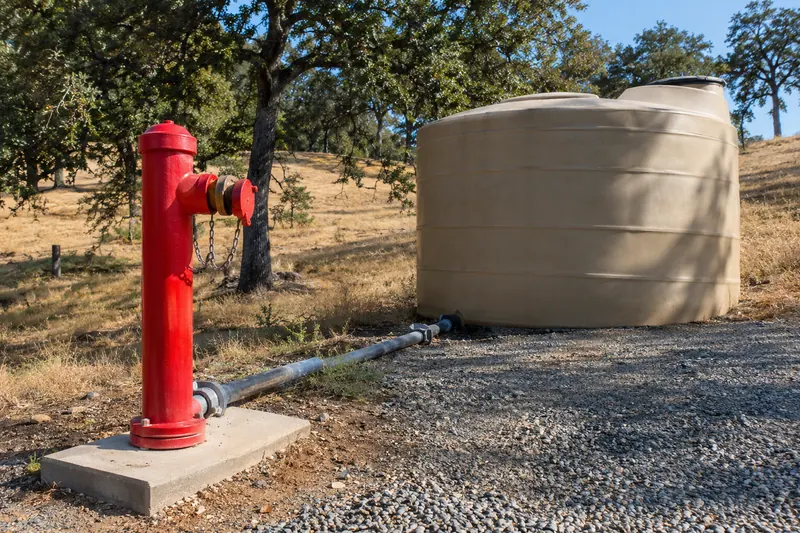
On rural parcels under SLO County Fire, the water a fire engine can draw from is part of the building permit, not an afterthought. The county's Standard 1 sets the dedicated reserve at no less than 2,500 gallons, citing NFPA 1142, and says most homes will need a tank of at least 5,000 gallons so daily household use does not eat into that reserve. The fire marshal's office decides the exact amount for each site.
Where do the fire water rules come from?
They start with state law and get stricter at the county. Public Resources Code 4290 tells the Board of Forestry to set minimum fire safety rules for State Responsibility Area land and Very High Fire Hazard Severity Zones, and one item on that short list is "minimum private water supply reserves for emergency fire use." The rules cover building in the State Responsibility Area approved after January 1, 1991, and in the very high hazard zones after July 1, 2021.
The state's emergency water article, part of the regulations in 14 CCR §1270 and onward, says what the water must do but sets no gallon figure. The volume comes from NFPA 1142 and from the local fire agency. SLO County Fire applies these rules to new homes, remodels, changes of occupancy, code violation permits and use permits, and it has adopted tighter local standards. Where two codes conflict, the more stringent one wins.
How many gallons does a new house need?
For most single homes the answer is a 5,000-gallon tank. Standard 1 puts the dedicated fire reserve at a minimum of 2,500 gallons and explains that the reserve plus average household use is what pushes the usual tank size to 5,000 gallons. Houses of 5,000 square feet or more get a calculated figure from a C-16 fire protection contractor or a fire protection engineer.
Three details often surprise owners. SLO County Fire does not insist on a separate fire tank, only on the dedicated amount being there. A home with fire sprinklers has its storage set by the C-16 contractor who designs the sprinkler system. And a home on a community water system is held instead to a fire flow, which Standard 1 sets at 1,000 gallons per minute for 2 hours for a structure under 3,600 square feet, backed by a signed will-serve letter from the water supplier.
- Minimum dedicated fire reserve2,500 gallons
- Usual tank size for most homes5,000 gallons
Source: SLO County Fire Standard 1
Can several smaller tanks be linked together?
Not without approval. Standard 1 calls the practice daisy chaining and says it is strictly prohibited. Exceptions need the fire department's sign-off before anything is built, and an approved multi-tank layout must have every valve chained and locked open, monitored tamper resistance on each tank, and a single common manifold.
The state rules do allow fire water and structural firefighting water to share storage unless a local ordinance or the fire agency says otherwise. For how tanks are sized, set and plumbed for everyday use, see our story on water storage tanks, and on booster pumps for how water gets from the tank to the taps.
What does the fire department connection look like?
It is a standpipe near the driveway that a fire crew can hook into, and the county spells out its placement. The CAL FIRE SLO residential fire connection spec, dated July 2025, says the connection must be in and working before and during construction, which matches the state rule that required fire water be serviceable while the house is going up.
| Item | Requirement |
|---|---|
| Distance from road or driveway | within 10 feet of the edge |
| Outlet height | 24 to 36 inches above finished grade |
| Distance from structures | between 50 and 150 feet from all of them |
| Marker | 3-inch blue reflector meeting county requirements |
| Nut and cap | pentagon hex nut; brass or plastic cap |
| Slope | not next to a slope steeper than 16% |
| Clear area | 10-foot clear zone kept around it |
The state regulation sets a hydrant at 18 inches above the finished surface, with a 2½-inch National Hose male thread for pressure and gravity systems and 4½-inch for draft systems. The county's 24 to 36 inch outlet height is the stricter local figure, and it is the one that applies on SLO County sites. The July 2025 county spec does not state a thread size, so the 2½-inch figure comes from the state rule; confirm it with the fire marshal. Each water source also gets a reflectorized blue marker at least 3 inches across, mounted on the driveway address sign on a fire-retardant post.
Why must the reserve stay full?
Because the whole point is water that is there on the worst day. The state's stated intent is that emergency water be "available, accessible, and maintained." Standard 1 adds that domestic demand comes on top of the fire storage. How one tank keeps its reserve untouched while the house draws from it is a design question for the plan reviewer and the licensed contractor; ask the fire marshal's office what layout it accepts before the tank is ordered.
Upkeep matters as much as size. EPA advice for drinking water tanks calls for vents screened with 24-mesh non-corroding screen and overflow lines protected from animals and insects; see our brief on tank care and cleaning. If you top up storage by truck, our brief on hauled water covers who licenses haulers.
Is the county standard up to date?
Check before you design. Standard 1 cites the 2022 California Fire Code, while the 2025 California Building Standards Code took effect on January 1, 2026. Treat the county numbers here as its published standard and ask the fire marshal's office which edition it is applying now. The wider permit path for new homes is in our story on county rules for new wells and building; the vegetation side of fire safety is in defensible space and water.
Where to call
- County Fire marshal (CAL FIRE SLU) — required fire water, tank layout, the fire connection and plan review. Fire Marshal page
- County of San Luis Obispo, Planning & Building — the building permit the fire water is tied to. Planning & Building department
- Contractors State License Board — check any contractor's license and classification before signing. License Check
Common questions
Must the fire reserve sit in its own tank?
SLO County Fire says it does not require a dedicated fire tank, only the required dedicated amount. Many homes meet that with one 5,000-gallon tank that holds both the reserve and household water. The fire marshal's office decides what works on your site.
Can I connect two 2,500-gallon tanks to make 5,000?
Linking tanks is called daisy chaining, and Standard 1 prohibits it without prior fire department approval. Approved systems need locked-open valves, tamper monitoring on each tank and one common manifold.
Does a remodel trigger the fire water rules?
It can. SLO County Fire applies Title 14 to remodels, changes in occupancy and use permits as well as new homes. Ask the Fire Marshal's Office early in the permit process.
How high should the fire connection outlet be?
The county spec says 24 to 36 inches above finished grade, which is stricter than the state's 18-inch hydrant height. On SLO County sites the county figure applies.
My house is over 5,000 square feet. How much storage do I need?
Standard 1 says larger homes of that size need the amount calculated by a C-16 contractor or a fire protection engineer. The 2,500-gallon minimum still applies as a floor.
Sources
- CAL FIRE SLO / SLO County Fire — Standard 1, Water Supply (Rev2) — 2,500-gallon minimum, 5,000-gallon usual tank, daisy chaining, sprinklers, fire flow
- CAL FIRE SLO — Fire Department Connection Specs, July 2025 — connection placement, height, reflector, cap, clear zone
- SLO County Fire / CAL FIRE — SRA Fire Safe Regulations 2023 — 14 CCR Article 4 text, hydrant height and thread, blue markers, local scope
- California Public Resources Code §4290 — state duty to set private water reserves for fire
- California Building Standards Commission — Codes — 2025 code effective January 1, 2026
- U.S. EPA — Sanitary Protection of Drinking Water Storage Tanks: Vents, Drains and Overflows — screened vents and overflows