Septic · Story
How Septic Systems Work on Rural North County Lots
A septic system in San Luis Obispo County is permitted by County Planning & Building under a county program approved in 2020, and EPA says most household tanks need pumping every three to five years.
By the Ranch House Water desk · Updated · 7 min read
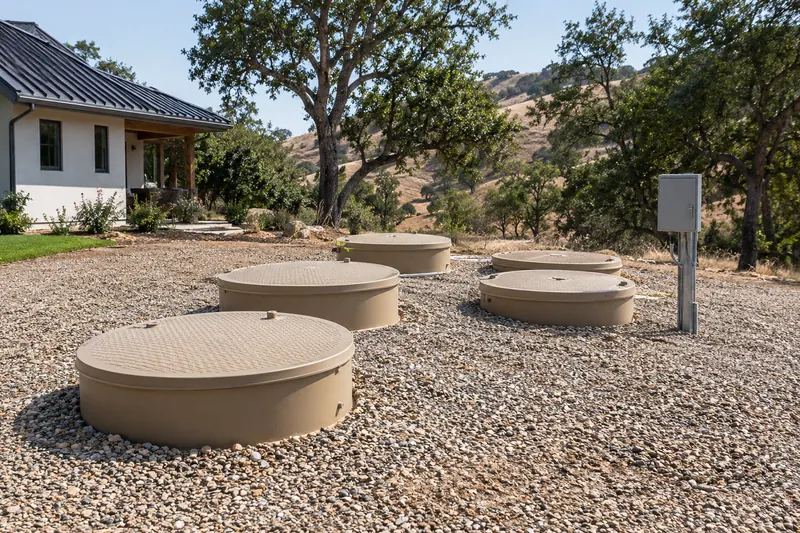
A septic system in San Luis Obispo County works under a county program that the Central Coast Regional Water Quality Control Board approved on September 25, 2020, in Resolution R3-2020-0024. That program covers the unincorporated county, which is where most north county ranchettes, vineyard homes and hillside parcels sit. The cities of Paso Robles and Atascadero are outside it, and Atascadero has its own plan.
How does a household septic system work?
A septic system is a small treatment plant buried in the yard: a watertight tank where solids settle, and a leach field, or drainfield, where liquid soaks into the soil. Heavy solids sink into a sludge layer, grease floats up as scum, and the clearer liquid between them flows out to the field.
When those two layers grow thick enough to crowd the outlet, it is time to pump, before solids escape and clog the field; EPA's measurements for that point are in our pumping brief.
Some systems add pumps, floats and treatment units. The county calls these non-conventional systems, and they come with extra paperwork, covered below and in our story on nitrogen-reducing septic areas.
Who sets the rules here?
The State Water Resources Control Board adopted its statewide septic policy, the OWTS Policy, in June 2012 and renewed it in April 2018 and again in April 2023 (State Water Board). San Luis Obispo County wrote its own local program under that policy, approved in 2020 (Central Coast Water Board).
Day to day, homeowners deal with County Planning & Building. The regional board's staff report says non-conventional systems need an operating permit from that department, and a Registered Environmental Health Specialist on its staff reviews designs and inspects work (staff report). County Environmental Health runs the separate program that permits liquid waste haulers, the trucks that pump tanks. The county says it is updating its program, so check the current version before you plan.
How much land does a septic system need with a well?
The county's septic program page says the minimum parcel size for a septic system plus an onsite well is 2.5 acres (county page, archived copy). The regional board's staff report also describes a 1-acre minimum for new subdivisions that it found protective. The 1-acre figure concerns septic density in general; 2.5 acres applies where one parcel holds both septic and its own drinking water well.
Under the state's Tier 1 rules, a dispersal system must sit at least 100 feet from water wells and monitoring wells, 100 feet from springs and flowing surface water, 200 feet from vernal pools, wetlands, lakes and ponds, and 5 feet from property lines and structures. Where the dispersal system is no deeper than 10 feet, the distance from a public water well is 150 feet (2023 OWTS Policy).
- Property lines and structures5 feet
- Water wells and monitoring wells100 feet
- Springs and flowing surface water100 feet
- Public water well, dispersal 10 ft deep or less150 feet
- Vernal pools, wetlands, lakes, ponds200 feet
Source: State Water Board
Seen from the well's side, DWR's standards ask for the same 100 feet between a drinking water well and any tank or leach field, and 150 feet where the waste goes to a cesspool or seepage pit (DWR well standards). Treat these as state minimums and confirm your parcel's numbers with County Planning & Building. Our story on drilling a new well covers the well side.
What changed for seepage pits and older systems?
The county program ended seepage pits for new subdivisions, and a failed seepage pit has to be replaced with a non-conventional system rather than another pit, according to the regional board's staff report. A financial-hardship repair may be allowed, but the property then carries a recorded declaration requiring an upgrade at sale. Buyers of older places should ask what kind of system is in the ground.
How often should a tank be pumped?
For a typical household, EPA's answer is once every three to five years (EPA), and the county encourages the same span. San Luis Obispo County also wants each pumping paired with an inspection by the licensed hauler, who records the results on a county form and sends a copy to Planning & Building (county O&M page, archived copy). Our brief on septic pumping and inspection covers the intervals in more detail.
Daily habits that keep a system working
Most damage comes from what goes down the drain and what drives over the field. EPA's rule of thumb is to flush nothing besides human waste and toilet paper; its list of things to keep out includes cooking grease, wipes, diapers, coffee grounds, cat litter, paper towels, medicines and household chemicals such as paint, antifreeze and pesticides. Don't park or drive on the drainfield, keep trees at a distance, and send roof drains away from the field.
Water use counts too. EPA notes that one leaky or running toilet can add as much as 200 gallons a day, so fix running toilets and spread laundry over the week. The agency does not recommend septic additives, since a working tank already holds the bacteria and other organisms it needs (EPA FAQ). If the system shows warning signs, see our story on septic trouble signs.
Where to call
- San Luis Obispo County Planning & Building, septic services — permits for new systems and repairs, parcel setbacks, and inspection reports filed after pumping. Their official page
- Contractors State License Board — confirm a contractor holds the C-42 Sanitation System license before work starts. License check
- State Water Resources Control Board — the statewide OWTS Policy behind local rules. Their official page
Common questions
Does the county septic program apply inside Paso Robles city limits?
No. The regional board's staff report says the county program does not apply to incorporated cities, naming Paso Robles and Atascadero among them. Atascadero has its own septic plan, approved December 7, 2018. Homes inside city limits should ask their city.
Can I build a home with a well and septic on a two-acre parcel?
The county's septic program page sets 2.5 acres as the minimum parcel for a septic system plus an onsite well. Smaller parcels may need a different water source or a different answer from the county. Ask County Planning & Building before buying or designing.
Do septic additives help?
EPA does not recommend them for household systems. A working tank already holds plenty of bacteria, enzymes and other organisms. Pumping on schedule and keeping harmful items out of the drains does more.
Who inspects my tank when it is pumped?
The county asks that the licensed septage hauler who pumps it also inspect it and complete the county's Septic Tank Inspection Report. Keep your copy with your property records.
Sources
- Central Coast Regional Water Quality Control Board — septic LAMP list — county program approval date; Atascadero's separate plan
- Central Coast Water Board — staff report, Item 15, September 2020 — areas covered, operating permits, seepage pits, hardship repairs, 1-acre subdivision minimum
- County of San Luis Obispo — LAMP page (archived copy) — 2.5-acre minimum with an onsite well; program update under way
- County of San Luis Obispo — Septic System Operation and Maintenance (archived copy) — inspection at pumping, form BLD-1030, three-to-five-year pumping
- State Water Resources Control Board — OWTS Policy page — policy adoption and renewals
- State Water Resources Control Board — 2023 OWTS Policy — Tier 1 setbacks
- California Department of Water Resources — Combined Well Standards — well-to-septic distances
- U.S. EPA — How to Care for Your Septic System — pumping interval, layer test, flushing list, drainfield care, leaky toilets
- U.S. EPA — Frequent Questions on Septic Systems — additives