Septic · Story
When a Septic System Starts to Fail, the Yard Usually Says So
Septic system failure signs include sewage backing up, slow or gurgling drains, sewage odors and soggy or unusually green ground over the tank or leach field.
By the Ranch House Water desk · Updated · 7 min read
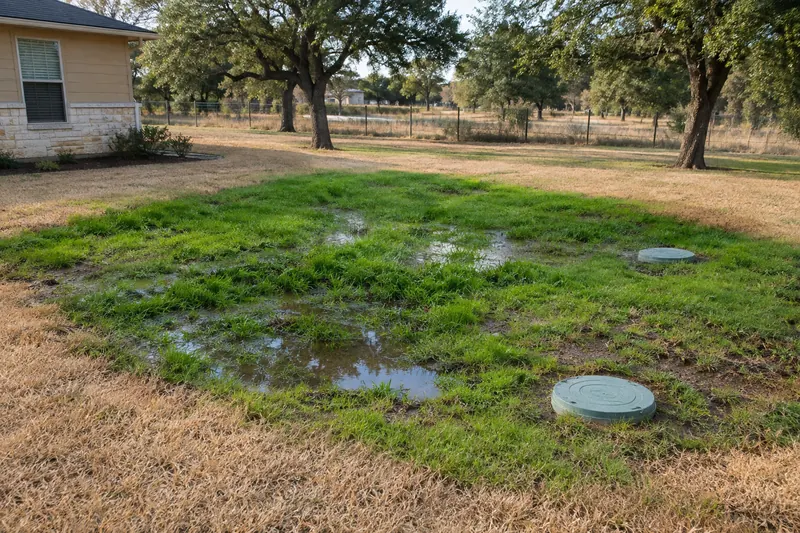
Septic system failure signs are listed plainly by the U.S. Environmental Protection Agency: sewage backing up into the house, slow drains, gurgling pipes, odors, and wet spots or lush grass over the tank or drainfield. In north San Luis Obispo County, where the in-town Paso Robles station averages just 15.26 inches of rain a year and almost none falls from June through September, a patch of bright green over the leach field in late summer stands out on an otherwise brown lot.
What are the warning signs?
EPA's list, from its frequently asked questions on septic systems, comes down to seven things you can see, hear or smell (EPA):
| Sign | Where you notice it |
|---|---|
| Sewage backing up into the home | Toilets, floor drains, lowest tub or shower |
| Slow drains | Sinks, tubs and showers throughout the house |
| Gurgling sounds in the plumbing | Drains and toilets after water runs |
| Standing water or damp spots | Ground over the tank or drainfield |
| Sewage odors | Around the tank, the field or indoors |
| Bright green, spongy, lush grass in dry weather | Over the tank or drainfield |
| High nitrate or coliform bacteria | Nearby surface water or drinking water wells |
One or two of these can have a simpler cause, such as a clog in a single drain line. Several at once, or any sign of sewage on the ground or in the house, points to the system itself. EPA also lists algae blooms in nearby ponds or creeks as a sign.
Why does the grass look greener over a failing field?
Grass grows thick over a failing field because it is getting water and nutrients that should have stayed underground. A working leach field releases liquid well below the root zone. When the soil clogs or the field is overloaded, effluent comes closer to the surface, and the turf above it greens up even through a dry August. With so little summer rain here, a green stripe in July or August is worth a closer look; our story on drought on a well has more on the local dry season.
Could a failing system affect my well?
Yes. EPA counts high nitrate or coliform bacteria in a drinking water well as one of the signs of septic failure, and the State Water Board's groundwater summary on nitrate names septic systems among the usual sources of nitrate in groundwater (State Water Board). California caps nitrate in drinking water at 10 mg/L measured as nitrogen (45 mg/L measured as nitrate). With a well on the same parcel, a septic problem is a reason to send a sample to an ELAP-accredited laboratory instead of judging by taste or smell. See testing your well water for how sampling works, and nitrate in well water for what a high result means.
What should I do first?
Cut water use and keep people and animals off any wet ground, then call for help. Hold off on laundry, long showers and the dishwasher, since every gallon goes to a system that already cannot take it. A toilet that runs nonstop can, by EPA's count, send up to 200 gallons a day into the tank, so listen for one and repair it.
Next, think about the system's age and history. EPA says many septic pumps and controls need replacing every 10 to 20 years, and that a system more than 25 to 30 years old is due for upgrade planning. If the tank has not been pumped in the three to five years EPA typically suggests, an overdue pumping may be part of the answer. Find your last pumping record; the county asks pumpers to leave the owner a copy of their inspection report, covered in our brief on septic pumping and inspection.
Skip the store-bought fixes. EPA advises against septic additives at home; the microbes a tank relies on are present without them.
What should I never do?
Never open the tank, lean over an open riser, or go into a tank or pit for any reason. Hydrogen sulfide, often called sewer gas, is the danger: federal health officials warn that people can stop smelling it within 2 to 15 minutes at around 100 ppm, and can lose consciousness above that level (ATSDR). A 1986 federal investigation recorded three deaths at a single waste tank after co-workers went in one after another to help (NIOSH). The brief septic tanks are confined spaces explains the danger further.
Don't dig into the field, drive equipment over it, or try to rod out the line between the tank and the field yourself. And don't run a hose or roof drain toward wet ground to flush it; EPA advises keeping rainwater drainage away from the drainfield.
Who fixes it, and what permits apply?
A licensed contractor fixes it, with a county permit. The Contractors State License Board's C-42 Sanitation System class covers people who install septic tanks, cesspools and other sewage disposal structures (CSLB), and County Environmental Health permits the liquid waste haulers who pump tanks. Repairs and replacements in the unincorporated county go through County Planning & Building under the county septic program approved in 2020.
That program carries rules that shape a repair. Under the regional board's staff report, a failed seepage pit must be replaced with a non-conventional system, not another pit, and owners facing hardship may get a lesser repair in exchange for a recorded declaration that requires an upgrade at sale (staff report). Parcels in Creston, Templeton North, Shandon and other focus areas face nitrogen-reduction rules for new construction, which nitrogen-reducing septic areas lays out. Our main story on septic systems on rural lots covers permits and setbacks.
Before anyone digs, check the contractor's license number on the CSLB site. A license is needed for any job that needs a building permit, and for any job of $1,000 or more under the state's minor-work rule in effect since January 1, 2026.
Where to call
- San Luis Obispo County Planning & Building, onsite wastewater services — repair and replacement permits, the county septic program and what your focus area requires. Their official page
- Contractors State License Board — look up a C-42 Sanitation System license before hiring anyone. License check
- State Water Board laboratory accreditation (ELAP) — locate a certified lab for nitrate and bacteria tests on your well. Lab search
- Emergencies — anyone overcome by sewer gas or inside a tank: 911.
Common questions
Is a gurgling toilet always a septic problem?
Not always. Gurgling can come from a partial clog in one line. But EPA lists gurgling as a failure sign, and if it comes with slow drains elsewhere, wet ground over the field or odors, have a licensed pumper or C-42 contractor look at the system.
Will pumping fix a failing leach field?
Pumping removes sludge and scum from the tank and can help if the tank was overdue. It does not repair a clogged or saturated field. A contractor's inspection will show which problem you have.
Should I add bacteria or enzyme products?
EPA does not recommend additives for household systems. A working tank already holds the bacteria, enzymes, yeasts and fungi it needs.
How old is too old for a septic system?
EPA says to start planning for an upgrade once a system is more than 25 to 30 years old, and that many pumps and controls need replacing every 10 to 20 years.
My well is near the leach field. Should I test it now?
Yes. High nitrate or coliform bacteria in a well is one of EPA's failure signs. Use an ELAP-accredited lab and follow its sampling instructions.
Sources
- U.S. EPA — Frequent Questions on Septic Systems — signs of failure, additives, lifespans
- U.S. EPA — How to Care for Your Septic System — pumping interval, leaky toilets, drainfield care
- State Water Board — GAMA groundwater summary: Nitrate — nitrate limit and septic systems as a source
- ATSDR (CDC) — ToxFAQs: Hydrogen Sulfide — loss of smell, loss of consciousness
- NIOSH — FACE 86-38, Three Dead, One Critical in Industrial Septic Tank — rescuer deaths at a waste tank
- Central Coast Water Board — staff report, Item 15, September 2020 — seepage pit replacement, hardship repairs
- CSLB — C-42 Sanitation System Contractor — what the license covers
- NOAA NCEI — 1991-2020 normals, Paso Robles station — annual rainfall
- California Business and Professions Code §7048 — $1,000 minor-work limit