Wells · Story
Drilling a New Well: Permits, Standards and the Paperwork After
Drilling a new well in San Luis Obispo County starts with a county permit filed by a licensed C-57 driller, follows state construction standards, and ends with a well log filed with the state.
By the Ranch House Water desk · Updated · 6 min read
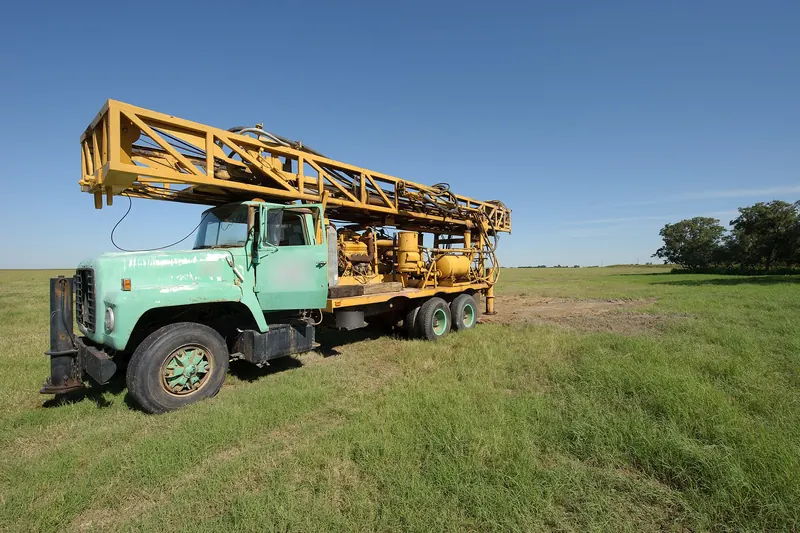
No drill rig should roll onto a parcel before the county has signed off. San Luis Obispo County Environmental Health states that it is unlawful to begin building a new water well without its approval first. On the oak and grassland parcels east of Paso Robles, where a home without a well has no water at all, that permit comes before anything else.
Who applies for the well permit?
The driller does, on the owner's behalf. The county's construction permitting page says the well driller submits a permit application for each well and pays the application fee. To drill in the county, the driller must hold a current C-57 Well Drilling license and keep a $25,000 surety bond on file with Environmental Health. Statewide, the GAMA program's well-owner booklet from the State Water Board agrees: domestic wells must be drilled by a C-57 licensee and meet local and state standards.
That makes choosing the driller the owner's real decision. Check the license on the Contractors State License Board's License Check page, ask whether the bond is on file with the county, and get the scope and price in writing; the hiring a well or pump contractor brief lists what to ask.
What standards does a new well have to meet?
California's minimum rules are the Department of Water Resources' Bulletin 74 well standards, which local agencies administer and enforce and may make stricter. DWR notes the standards were last updated in 1991 and are being rewritten, with a draft planned for public comment in fall 2026 and approval targeted for summer or fall 2027. Until then, the working text is the Combined Well Standards, Bulletins 74-81 and 74-90.
Two parts of those standards shape most rural wells. The first is the annular seal, the cement or clay plug packed around the outside of the casing to stop surface water from running down beside it: for an individual domestic well it must reach at least 20 feet below the surface, compared with 50 feet for a community supply well, and no seal may stop shallower than 10 feet. The second is distance from pollution, covered below.
- Individual domestic well20 feet
- Community supply well50 feet
- Floor for any annular seal10 feet
Source: DWR Combined Well Standards
Where on the parcel can the well go?
Uphill of anything that could foul it, where the ground allows, and outside the state's minimum distances: 100 feet from a septic tank, leach field or animal enclosure, a full 150 feet from any seepage pit or cesspool, and 50 feet from sewer lines. The county may ask for more on a given site, so plan the well, house pad, septic system and barns together on one sketch. The setbacks are listed in full in living on a private well.
Lot size matters too. A parcel smaller than 2.5 acres is too small, under the county's septic program, to carry a septic system and a private well together. See septic systems on rural lots for the other half of that plan.
Do Paso basin rules affect a new household well?
Some do, and the details are worth confirming before drilling. Under Executive Order N-3-23 of February 2023, permit offices in medium- and high-priority basins need written word from the groundwater sustainability agency first when someone wants to drill or alter a well, but the order exempts wells supplying less than two acre-feet a year to individual domestic users. DWR reported that part of the order still in effect as of March 2024; we did not confirm its status after that.
On the county side, a June 2026 copy of its Paso Robles basin page records that new homes stopped needing a one-for-one water offset at the start of 2022, but a new structure must still have a meter on its well. We could not confirm the full set of county rules for new wells in the basin today, so check with County Planning and Building and Environmental Health. Both county rules for new wells and building and household wells and basin rules treat these questions at length.
| Step | Who does it | What it produces |
|---|---|---|
| Choose a licensed driller | Owner | Signed contract |
| Apply for the county construction permit | C-57 driller | Environmental Health approval |
| Drill, case and seal the well | C-57 driller | Finished well to Bulletin 74 standards |
| Disinfect before use | Driller or pump contractor | Well ready for service |
| File the completion report within 60 days | Driller | Well log with DWR, the county and the owner |
| Test the water at an accredited lab | Owner | First lab results for the file |
What happens after the rig leaves?
The well is disinfected, the paperwork is filed, and the water is tested. State standards require a new domestic well to be disinfected before it is placed in service. Within 60 days of finishing, the driller must file a well completion report with DWR under Water Code Section 13751, through the state's online filing system; the GAMA booklet notes the owner receives a copy too. Keep it: the county asks for a copy if you ever apply to keep an unused well inactive. See finding your well log if one ever goes missing.
Then test. For a first test, County Environmental Health suggests the full list of primary standards along with coliform bacteria, then a yearly retest for any problem the lab finds. Sampling and labs are explained in testing your well water.
Where to call
- County Environmental Health, Well Program — the construction permit, setbacks for your site and the dry-well fee waiver. Water Well Construction Permitting
- County Planning and Building — basin rules, well meters and building permits. Water Programs
- Paso Robles Area Groundwater Authority — which groundwater agency covers your parcel. PRAGA
- Contractors State License Board — confirming the driller's C-57 license. License Check
Common questions
Can I pull the well permit myself?
The county's process has the driller submit the construction permit application and pay the fee on the owner's behalf, so the owner's job is to pick a licensed, bonded driller.
How deep does the seal on a domestic well go?
At least 20 feet below the surface under the state's Combined Well Standards, and never less than 10 feet for any well.
Does a new house well in the Paso basin need groundwater agency sign-off?
Executive Order N-3-23 exempts domestic wells supplying less than two acre-feet a year from the agency verification step. Confirm current county rules with Planning and Building and Environmental Health before drilling.
Who files the well log, and when?
The driller files the completion report with DWR within 60 days of finishing the work, and the owner should get a copy.
Is a dry-well replacement treated differently?
It still needs a permit and a C-57 driller, though a waiver of the permit fee may be available where the county has found low water impacts.
Sources
- County of San Luis Obispo — Water Well Construction Permitting (archived copy) — permit before drilling, driller applies, C-57 and $25,000 bond, fee waiver
- DWR — Well Standards (archived copy) — Bulletin 74, local enforcement, 1991 standards, rewrite timeline
- DWR — Combined Well Standards, Sections 8, 9 and 11 (archived copy) — setbacks, seal depths, disinfection
- DWR — Well Completion Reports (archived copy) — 60-day filing rule
- State Water Board GAMA — A Guide for Private Domestic Well Owners (June 2025) — C-57 drilling, owner copy of the log
- Executive Order N-3-23 (February 13, 2023) — well permit verification and domestic exemption
- DWR — Groundwater Well Permitting analysis, March 2024 (archived copy) — order still in effect as of March 2024
- County of San Luis Obispo — Paso Robles Groundwater Basin page, June 2026 (archived copy) — offset expired, meters still required
- County of San Luis Obispo — LAMP page (archived copy) — 2.5-acre minimum with septic and well
- County of San Luis Obispo — Well Owner's Checklist (archived copy) — first water test recommendation