Wells · Story
Living on a Private Well: What the Owner Answers For
Private well owners in San Luis Obispo County carry the whole job themselves: no agency monitors the water, so testing, upkeep and records fall to the household.
By the Ranch House Water desk · Updated · 7 min read
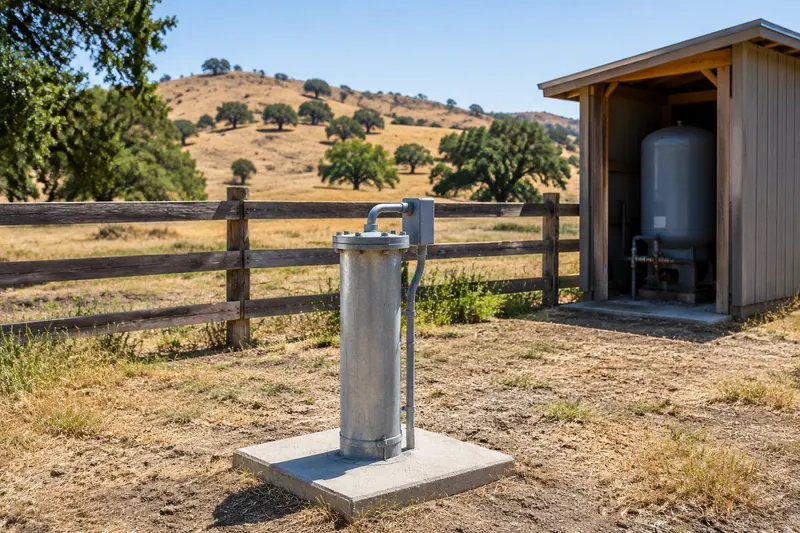
A private well makes a rural household its own small water company, without the staff. County Environmental Health says plainly that no agency or company oversees the water drawn from a private, non-commercial well, and that the owner must make sure it is safe to drink. On a ranchette outside Creston or a vineyard parcel near San Miguel, nobody else is watching.
Who is responsible for a household well in SLO County?
The owner is. The county says so directly, and the State Water Board's GAMA booklet for well owners adds that the state leaves water quality in most household wells unregulated, leaving owners to maintain their wells and encouraging them to test. What the county does handle is permits: its Environmental Health Services Well Program approves the construction and destruction of wells and keeps a public map of well permit data.
That split matters. A permit on file says a well was built to a standard on the day it was finished. It says nothing about the water coming out of it this year, or about a cracked cap, a leaking pressure tank or a new corral uphill. Those are the household's to notice.
What should an owner check each year?
Plan on a lab test every year for coliform bacteria and nitrate, with conductivity or dissolved solids alongside, and a broader metals panel, arsenic included, at purchase and every few years later. The GAMA booklet recommends yearly tests for total coliform bacteria, nitrate and electrical conductivity, and a metals panel once every 5 to 10 years, sooner after a big change. The county's checklist also says to test whenever the taste, odor or look of the water changes. Testing your well water walks through labs and sample bottles, and households that may qualify can use the free Central Coast well testing program.
Beyond the water, walk out to the wellhead. The state booklet says wells should be inspected yearly for damage and that a licensed well drilling contractor, not the owner, should make any repair. Look at the cap, the casing and the ground around them; note anything loose, cracked or wet.
How far must a well sit from a septic system?
Under the state's Bulletin 74 well standards, a well should keep at least 100 feet from a watertight septic tank or leaching field, 150 feet from a cesspool or seepage pit, 50 feet from any sewer line and 100 feet from an animal or fowl enclosure. Those are state minimums; the local agency may ask for more, or approve less case by case, so San Luis Obispo County Environmental Health sets the setbacks for your parcel. The same standards say a well should sit up the groundwater gradient from likely pollution where possible.
These distances matter most when something new goes in. A barn, a horse pen or a replacement leach field placed too close can undo a sound well. The septic half of the same parcel is covered in septic systems on rural lots.
- Sewer line50 feet
- Septic tank or leach field100 feet
- Animal or fowl enclosure100 feet
- Cesspool or seepage pit150 feet
Source: DWR Combined Well Standards
Keeping the wellhead high, dry and uncluttered
The county's Well Owner's Checklist asks owners to keep the top of the well at least one foot above the ground, slope the soil away from it, and not pile dirt, leaves or other material around it. When mixing pesticides or fertilizer, keep the hose out of the spray tank so nothing siphons back into the water line. The GAMA booklet adds a simple rule: do not mix or store paint, pesticides, herbicides or gasoline within 50 feet of the well.
On many properties the wellhead ends up beside the tractor shed or the fuel can. Moving those few things is one of the cheapest protections a household has.
Which records are worth keeping?
Keep the well completion report (the driller's log), every lab result, and receipts for pump, tank and treatment work, in one folder. The driller's log records how deep the well is, how it was cased and sealed, and what the driller found; the state booklet notes it is sent to the permitting agency, the Department of Water Resources and the owner. If yours is missing, our brief on finding your well log explains the state's search map.
Lab results are most useful side by side. A nitrate figure that climbs over several years tells an owner more than any single number, and the GAMA booklet treats a conductivity result that is significantly different from the last one as a reason to look closer.
Where does the owner's part stop?
An owner can read the pressure gauge, note symptoms, switch the pump breaker off, keep records, take samples the way the lab instructs, and keep the wellhead clear. The county checklist says to always use licensed or certified well drillers and pump installers when a well is built, a pump is installed or the system is serviced. In California that is a C-57 Well Drilling contractor, whose license you can check with the Contractors State License Board. Our pages on the well pump and pressure tank, hiring a well or pump contractor and inactive and abandoned wells go further.
Where to call
- County Environmental Health (Well Program) — permits, well data, and the county pages written for people on wells. Private Well Owner Resources
- State Water Board, Environmental Laboratory Accreditation Program — finding an accredited lab for well water tests. ELAP lab search
- Contractors State License Board — confirming a C-57 license before pump or well work. License Check
Common questions
Does the county test my private well for me?
No. Testing is left to the household; the county does not sample private wells. It does point owners to testing labs and to the free Central Coast testing program for those who qualify.
How often should a private well be tested?
Yearly for coliform bacteria and nitrate, with conductivity or dissolved solids, and a metals panel when you buy and every few years after. Test again whenever taste, smell or color changes.
Can I fix a cracked well cap myself?
The State Water Board booklet advises against owners repairing wells themselves and says to contact a licensed well drilling contractor. Keeping debris away and the ground sloped away from the well is the owner's part.
Are the setback distances the same on every parcel?
The state figures are minimums. County Environmental Health can require more, or approve less case by case, so ask the county about your parcel before building near a well.
Sources
- County of San Luis Obispo — Private Well Owner Resources (archived copy) — no agency monitors private wells; owner responsible
- State Water Board GAMA — A Guide for Private Domestic Well Owners (June 2025) — state role, yearly tests, inspection, 50-foot chemical rule, driller's log
- County of San Luis Obispo — Well Owner's Checklist (archived copy) — wellhead height, back-siphonage, licensed installers, when to test
- DWR — Combined Well Standards, Sections 8 and 9 (archived copy) — setback distances, upslope siting
- CDC — How to Disinfect Wells After an Emergency — well pit gas warning
- County of San Luis Obispo — Well Program (archived copy) — permits and well data map
- Contractors State License Board — C-57 Well Drilling Contractor — who installs and repairs wells and pumps