Water Quality · Story
Boron in the Well: No Legal Limit, but Vines Notice
Boron in well water has no enforceable drinking water limit in California; the state's notification level is 1 mg/L, and grapevines can suffer above about 1 ppm.
By the Ranch House Water desk · Updated · 5 min read
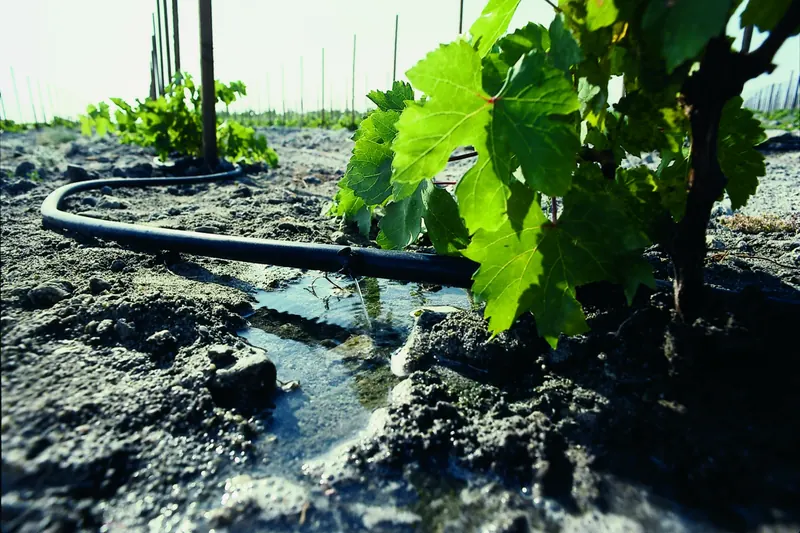
Boron sits in an odd spot for north county households. It is one of the substances the Paso Robles groundwater plan tracks with formal thresholds, set for agricultural supply wells, yet there is no enforceable drinking water limit for it. For a family with a well, a garden and a few rows of vines beside the house, the number matters twice.
Is there a legal limit for boron in drinking water?
No. California has no maximum contaminant level for boron. Instead, the State Water Board keeps a notification level of 1 mg/L, confirmed in its June 2026 overview of notification levels. The board's history note says that level was first set at an uncertain date, thought to be in the early to mid-1990s. The health effect behind it is decreased fetal weight in laboratory rats, a developmental effect.
A notification level is an advisory figure, not an enforceable cap. For a private well nobody is notified of anything, because no agency watches the well. The number is still the best yardstick the state offers for deciding whether the drinking water deserves attention.
How do the boron benchmarks compare?
The state's boron summary lists three figures, all in micrograms per liter. Labs report boron from 100 µg/L up. The state notification level is 1,000 µg/L, which is the same 1 mg/L written another way. The U.S. EPA's health advisory for non-cancer effects is higher, at 5,000 µg/L, according to the GAMA boron summary.
- Lowest level labs must report100 µg/L
- California notification level1,000 µg/L
- EPA health advisory, non-cancer5,000 µg/L
Source: State Water Board GAMA
Where does boron in groundwater come from?
Mainly from the rock. The state's summary traces it to water leaching rocks and soils that contain borate and borosilicate minerals. Federal scientists sampling the shallow layer that household wells reach, across the two-county Monterey and SLO region, listed boron among the trace elements found at high relative concentrations, alongside arsenic, iron, manganese, molybdenum, selenium and strontium. That study did not publish a separate figure for the Paso Robles area, so the only way to know your own well's number is to test it.
Why do grapevines care?
Because the gap between too little and too much boron is narrow for vines. University of California researchers writing in California Agriculture said irrigation water carrying more than 1 part per million of boron can lead to vine toxicity. They put the range from deficiency to toxicity at 0.15 ppm to 1 ppm in saturated soil extracts, and 30 ppm to 80 ppm in leaf tissue.
For a backyard planting or a few acres of estate vines watered from the house well, a lab number for boron is worth having before the drip lines go in. In water, one part per million is the same as one milligram per liter, so a single test answers both the drinking question and the vineyard question. For questions about other crops or garden plants, ask UC Cooperative Extension; the vine figures here are specific to grapes. The Paso Robles groundwater basin story explains the plan that tracks boron in farm wells.
How do you sample a well for boron?
Use plastic. The State Water Board warns that ordinary borosilicate glass, the kind sold as Pyrex, can contaminate a boron sample, and that only plastic or PTFE should touch the water when collecting, storing or handling it for boron. Ask an ELAP-accredited lab, found through the State Water Board's lab map, to send bottles meant for boron. If you are already ordering a metals panel, ask whether boron can be added. The yearly schedule and the less frequent full panel are set out in testing your well water.
What removes boron from water?
Few methods do it well. The state says that once boron compounds dissolve they behave like a salt and are hard to take out. Distillation and ion exchange units are named as effective, and reverse osmosis is also described. Treatment should follow a confirmed lab result, the unit should be registered in California for the claim it makes, and the treated water should be tested again once it is running. A household softener is designed for hardness, not boron; see softeners and filters for well water. For the irrigation side, treating large volumes is a different problem from treating a kitchen tap, and a grower's question belongs with farm advisers.
Boron and the other local suspects
Boron rarely travels alone in these results. The same USGS study flagged arsenic and nitrate, and the free Central Coast program reports nitrate and hexavalent chromium as its most common failures. A boron test is a good moment to check the others; see our stories on arsenic and nitrate.
Where to call
- State Water Board ELAP — find an accredited lab that runs boron with plastic sampling bottles. Lab map
- UC Agriculture and Natural Resources — research on boron and grapevines; ask the local Cooperative Extension office about irrigation water. Boron and vines (PDF)
- Paso Robles Area Groundwater Authority — runs the subbasin plan, with water quality thresholds, including boron in farm wells. PRAGA
- County Environmental Health, private well resources — local well owner questions. County page
Common questions
Is boron in my well dangerous to drink?
California has no enforceable limit. The state's notification level is 1 mg/L, based on developmental effects in rats; above it, consider treatment and talk with your doctor.
Can I use a glass jar to collect a boron sample?
No. The State Water Board says borosilicate glass can contaminate the sample. Use the plastic or PTFE bottle the lab provides.
My well has 1.5 mg/L of boron. Can I water the vines with it?
UC research says irrigation water above 1 ppm can lead to vine toxicity, and 1.5 mg/L is the same as 1.5 ppm. Talk with a farm adviser before relying on that water for grapes.
Will a reverse osmosis unit take boron out?
The state describes reverse osmosis among boron treatments, with distillation and ion exchange named as effective. Check the unit's registration for boron and retest after it is installed.
Sources
- State Water Board — Notification Levels and Response Levels overview (June 2026, docx) — 1 mg/L notification level, history, health endpoint
- State Water Board GAMA — Boron in groundwater (PDF, rev. Nov 2017) — benchmarks, sources, sampling materials, treatment
- UC ANR, California Agriculture 59(3) — boron in vineyards (PDF) — vine toxicity above 1 ppm; deficiency-to-toxicity window
- USGS — SIR 2018-5057 — boron at high relative concentrations in shallow groundwater
- State Water Board — comments on the Paso Robles Area GSP, Dec 8, 2020 (PDF) — boron thresholds in agricultural supply wells
- State Water Board — ELAP — accredited labs