Water Quality · Story
How to Test a Private Well in North County, and How Often
Well water testing around Paso Robles means a lab check for bacteria and nitrate at least once a year, plus a full metals test at purchase and every few years.
By the Ranch House Water desk · Updated · 7 min read
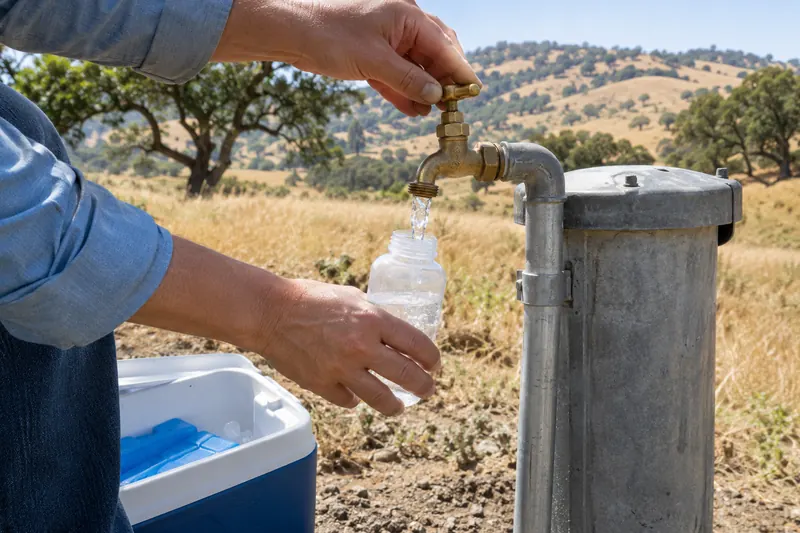
No one else will test a household well for you here. County Environmental Health is clear that no outside agency or company checks water from private, non-commercial wells, so the schedule, the lab and the follow-up all sit with the owner.
Who is responsible for testing a well here?
The owner is. The State Water Board's well-owner booklet says the state leaves most domestic wells unregulated and that owners are encouraged to test. A house on a shared or mutual system with a state permit is different; if your bill comes from a water company, its annual Consumer Confidence Report is where the numbers live. Everyone with their own pump and pressure tank, from oak-studded ranchettes east of Paso Robles to the small lots outside Templeton, is on their own. Our story on living on a private well covers the rest of that job.
What should a north county well be tested for, and how often?
Every year, send off samples for bacteria and nitrate along with conductivity or dissolved solids; once at purchase and every few years after, order a metals panel that includes arsenic. That plan blends three official sources. The county's well owner's checklist asks for one first test against the primary drinking water standards plus total coliform, then a yearly retest for anything that showed up. The state booklet lists total coliform bacteria, nitrate and electrical conductivity every year, and minerals and metals every 5-10 years. The U.S. EPA adds total dissolved solids and pH to its yearly list.
Local groundwater gives reasons to take the metals panel seriously. A U.S. Geological Survey study of shallow, domestic-depth groundwater in Monterey and San Luis Obispo counties found arsenic, boron, uranium, gross alpha and nitrate among the substances at high relative levels. Each has its own story here: arsenic, nitrate and boron.
| Test | How often | Result that calls for action |
|---|---|---|
| Total coliform bacteria | Every year | Present: find the cause, disinfect, retest |
| Nitrate | Every year | Over 10 mg/L as N (45 mg/L as nitrate) |
| Electrical conductivity | Every year | Over 1,600 µmhos/cm, or a big change from last time |
| Minerals and metals (arsenic, lead, iron, manganese and others) | Every 5-10 years, or after a significant change | Arsenic over 0.01 mg/L; lead over 0.015 mg/L; iron over 0.3 mg/L; manganese over 0.05 mg/L |
| Volatile organic compounds | When there is a reason, such as a fuel station or shop nearby | Any detection: ask the lab to retest |
When should you test outside the regular schedule?
Test again any time the water changes in taste, smell or look, after a pump or well repair, and after flooding or digging near the wellhead. The county checklist asks for a test whenever contamination is suspected. EPA suggests testing more often in a home with small children, elderly adults or someone pregnant or nursing. Properties near landfills, machine shops, dry cleaners, gas stations or auto repair yards should add volatile organic compounds, metals, dissolved solids and petroleum hydrocarbons, per the county list.
After a well is disinfected, CDC says to wait at least 7-10 days and sample only once the chlorine is gone. The brief on well disinfection explains which parts of that job belong to a licensed well or pump contractor.
How do you find an accredited lab?
Use the State Water Board's Environmental Laboratory Accreditation Program, known as ELAP, which keeps a map of accredited labs. Ask the lab which tests it runs for private drinking water wells and whether it will send bottles. The county notes that bacteria, metals, nitrate and many chemicals can only be found by laboratory testing, and that labs supply the sampling bottles and can help you sample your own well.
Store kits have a narrow use. The state booklet warns that home kits may detect a substance without giving a numerical concentration, and a number is what you compare with a legal limit. For cost, the booklet quotes basic analyses at $100-$400; treat that as its average, not a local quote.
Taking the sample
Follow the lab's written instructions exactly, because bottle type, preservative, holding time and delivery deadline differ by test. Boron needs plastic or PTFE containers; the state warns that borosilicate glass can contaminate a boron sample. Keep a notebook with the date, the tap used and whether the water ran through a softener or filter, so next year's result compares like with like.
How do you read the report?
Match each line to its drinking water standard and its units. Arsenic is reported in micrograms per liter (µg/L) and has a limit of 10 µg/L. Nitrate may appear "as N," with a limit of 10 mg/L, or "as nitrate," with a limit of 45 mg/L; those are the same limit in different units. Boron has no enforceable limit, only a state notification level of 1 mg/L. Uranium's limit is 20 pCi/L and gross alpha's is 15 pCi/L, according to the State Water Board.
A result over a standard means two things: confirm it with a second sample, and only then pick treatment certified for that contaminant. California keeps a registry of water treatment devices tested to reduce health-related contaminants, searchable by contaminant. Test again after the unit is running. Our story on softeners and filters for well water covers the hardware.
The free program and public results
The Central Coast Drinking Water Well Testing Program has sampled about 1,058 wells since October 2018, and about 33 percent did not meet drinking water standards, most often for nitrate and hexavalent chromium. Well locations and results go into the state's public GAMA map, with names kept private. Details are in our brief on free well testing.
Where to call
- SLO County Environmental Health Services, Well Program — the county well owner checklist and local private well questions. Private Well Owner Resources
- State Water Board ELAP — find a lab accredited for drinking water tests near you. Lab search
- Central Coast Drinking Water Well Testing Program — free sampling for wells that qualify, reachable through the county's private well page. Program summary
- State Water Board, residential treatment devices — check that a unit is registered for the contaminant the lab reported. Device registry
Common questions
Can I just use a test strip from the hardware store?
A strip can hint at hardness or pH, but the state notes that home kits may not give a numerical concentration. Health limits for nitrate and arsenic are numbers, so use an accredited lab for anything that affects drinking.
Does a new well come with a water test?
Not automatically. The driller files a well completion report on construction, which is not a water quality report, so plan a full lab test before the family drinks the water.
My neighbor's well tested fine. Does that cover mine?
No. Wells draw from different depths and sit at different distances from septic systems and pens, so each well needs its own result.
How long should I keep old lab reports?
Keep them for as long as you own the well. A change from one year to the next is often the first sign of trouble, and buyers may ask for the history.
Who pays if the result is bad?
Usually the owner. The free regional program does not supply water itself, but it can point income-qualified households to separate bottled water help.
Sources
- County of San Luis Obispo — Private Well Owner Resources — owner responsibility; lab-only contaminants; labs supply bottles
- County of San Luis Obispo — Well Owner's Checklist (PDF) — first test, yearly retests, when to test more
- State Water Board GAMA — A Guide for Private Domestic Well Owners (June 2025) — yearly tests, metals interval, action levels, home kit limits, cost range
- U.S. EPA — Protect Your Home's Water — yearly list and extra testing triggers
- State Water Board — ELAP — accredited lab map
- USGS — SIR 2018-5057, shallow groundwater in Monterey and San Luis Obispo counties — substances found at high relative levels
- Central Coast Water Board — Drinking Water Well Testing Program summary (PDF) — wells sampled, failure rate, public results
- CDC — How to Disinfect Wells After an Emergency — 7-10 day wait before sampling
- State Water Board — Radionuclides in groundwater (PDF) — uranium and gross alpha limits
- State Water Board — Residential Water Treatment Devices — registered device search