Water Quality · Story
Arsenic in North County Wells: The Limit, the Test, the Fix
Arsenic in well water has a California limit of 10 µg/L; it is mostly natural, common enough in the Paso Robles subbasin to be watched, and found only by a lab.
By the Ranch House Water desk · Updated · 6 min read
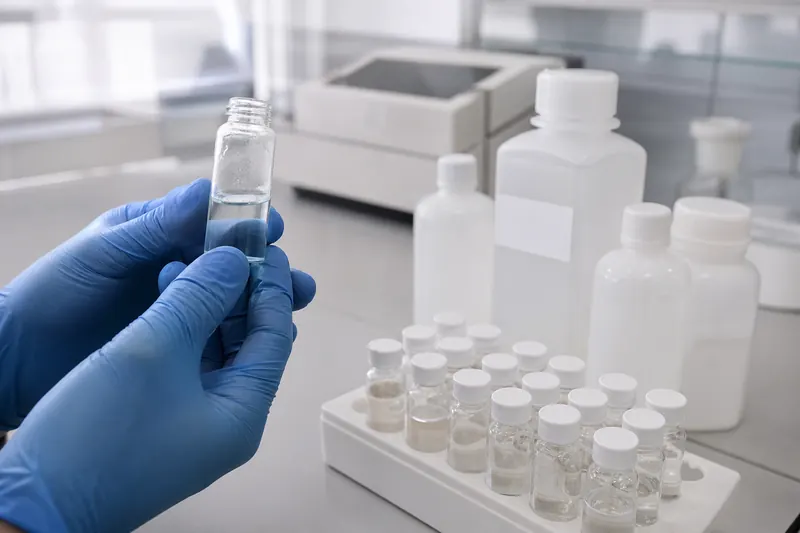
Arsenic is the metal most worth a well owner's attention in this part of the county. In 2020 the State Water Board told the state's water department that arsenic shows up above the 10 microgram limit often enough within the Paso Robles subbasin that domestic wells should be added to the basin's monitoring, and it noted that many of the arsenic results on its map came from household wells.
Where does arsenic in a well come from?
Mostly from the ground itself. The State Water Board's arsenic summary says the metal is found in groundwater predominantly due to natural sources, so a well can carry it even on land that has never seen a mine, a dump or a spray rig. That is why arsenic belongs on the metals panel for every well, including new ones drilled on clean pasture.
A U.S. Geological Survey look at shallow groundwater in the Monterey Bay and Salinas Valley basins found arsenic was the trace element that contributed most often to high concentrations, both in the deeper aquifer that public systems use and in the shallow layer many household wells tap. The same USGS work points out that water from private wells is usually drunk without any treatment, unlike water from public wells.
What do the numbers mean?
The drinking water standard (MCL) for public systems is 10 µg/L, the same in California and under federal rules, and it is the usual yardstick for a private well. That figure is also written as 0.010 mg/L; some lab reports use one unit and some the other, so check the column heading before you compare. The state's public health goal is far lower, at 0.004 µg/L. The limit is the enforceable number; the goal is a health target, and the gap between them is wide. Labs report down to 2 µg/L.
- State public health goal0.004 µg/L
- Lowest level labs must report2 µg/L
- State and federal limit10 µg/L
Source: State Water Board GAMA
For a sense of local scale, the San Miguel Community Services District, which runs on groundwater wells alone, reported arsenic averaging 4.0 ppb in its distribution system, ranging from 3.0 to 6.5, in its 2025 Consumer Confidence Report. That is a treated, regulated town system. A private well a few miles away can read higher or lower, and only its own test will say which.
Why does it matter for health?
Arsenic is a known human carcinogen, and the state's summary links long-term drinking of it to higher risk of cancer of the liver, bladder, kidney, lungs and skin. Long exposure can also darken patches of skin and raise small corn- or wart-like growths on the palms, soles and torso. The harm builds over years of drinking, which is why a household that has been on the same well for a decade has good reason to have a current number.
How do you test a well for arsenic?
Order a metals panel from a lab accredited through the State Water Board's ELAP program, and follow its bottle and delivery instructions. The state's well-owner booklet lists arsenic among the metals to test every 5-10 years or after a significant change, with action above 0.01 mg/L. We suggest a first panel when you buy the property, then repeats every few years. The free Central Coast well testing program includes arsenic among the health-related contaminants it checks. Our story on testing your well water covers the full schedule.
What treatment works, and how do you check it?
Treatment comes after a confirmed lab result, never before. The State Water Board lists four families of arsenic treatment: precipitation processes, adsorption on activated alumina, anion exchange, and membrane filtration such as reverse osmosis and electrodialysis reversal. That list describes treatment in general; it does not single out under-sink units, and we found no California page that recommends one point-of-use design for homes.
What California does offer is a registry. Devices sold in the state with health claims are meant to be evaluated and tested to reduce the contaminants on the box, and the registry can be searched by contaminant, including arsenic. Pick a unit registered for arsenic reduction at the level your report shows, keep up with its filter or membrane changes, and send a new sample from the treated tap once it is running. A water softener is not arsenic treatment, so don't count on one; our story on softeners and filters explains what each kind of equipment is built to do.
What about the basin's monitoring?
The 2020 State Water Board letter asked the basin's planners to add arsenic standards and monitoring for public supply and domestic wells, which were not in the plan's water quality network at the time. Our page on the Paso Robles groundwater basin follows that plan and the authority that now runs it. None of it replaces your own test.
Where to call
- State Water Board ELAP — locate an accredited lab that runs arsenic and other metals. ELAP lab map
- State Water Board, Residential Water Treatment Devices — search registered units by contaminant before buying. Device search
- County Environmental Health, well program — local questions about private wells and the county checklist. Private well resources
- GAMA groundwater map — public results for wells near you, by location. GAMA map
Common questions
Does boiling well water remove arsenic?
No source we rely on lists boiling as arsenic treatment. The State Water Board's list is precipitation, activated alumina, anion exchange and membrane filtration such as reverse osmosis.
What if my result is under 10 but above zero?
A result such as 8 µg/L is under the 10 µg/L standard but sits far above the state's health goal of 0.004 µg/L. Keep testing every few years, and raise any health questions with your doctor.
Can arsenic levels change over time?
One old result is not the last word. The state suggests repeating metals tests every 5-10 years or after a significant change to the well or the water.
Is arsenic only a problem for drinking?
The health risk in the state's summary comes from swallowing it over many years. Ask the lab and the device registry which taps need treatment for your result; the drinking and cooking water is the priority.
Sources
- State Water Board GAMA — Arsenic in groundwater (PDF, rev. Oct 2017) — limit, health goal, reporting level, health effects, natural sources, treatment types
- State Water Board — comments on the Paso Robles Area GSP, Dec 8, 2020 (PDF) — arsenic prevalence in the subbasin and domestic wells
- USGS — FS 2018-3078, public-supply and shallow aquifers (PDF) — arsenic most common trace element at high concentrations
- San Miguel CSD — 2025 Consumer Confidence Report (PDF) — local system arsenic results
- State Water Board GAMA — A Guide for Private Domestic Well Owners (PDF) — metals test interval and action level
- State Water Board — ELAP — accredited labs
- State Water Board — Residential Water Treatment Devices — device registration and search
- USGS — SIR 2018-5057 — private well water usually consumed untreated