Water Quality · Story
Nitrate in Rural Wells: Why Babies Come First
Nitrate in well water should stay under the 10 mg/L drinking water standard (as nitrogen); infants under six months face the greatest risk, and boiling does not remove it.
By the Ranch House Water desk · Updated · 6 min read
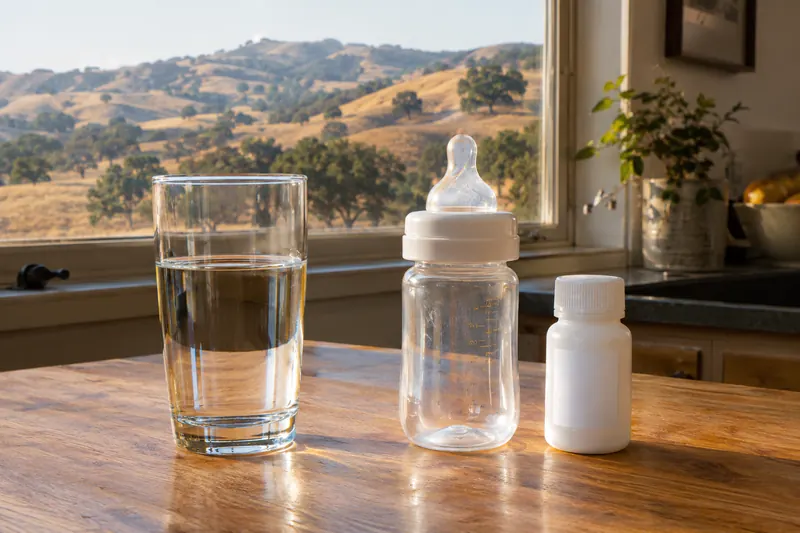
Nitrate is the contaminant the free Central Coast testing program finds most often. Of about 1,058 wells it has sampled since 2018, roughly a third did not meet drinking water standards, and the regional water board names nitrate and hexavalent chromium as the most common causes. For households on their own wells among the vineyards, pastures and septic-served ranchettes of north county, that makes a yearly nitrate test basic upkeep.
What is the limit, and why are there two numbers?
The California and federal limit is 10 mg/L measured as nitrogen, which equals 45 mg/L measured as the whole nitrate ion. Both figures appear in the State Water Board's nitrate summary, and labs use either one. Before comparing, look for "as N" or "as NO3" beside the result. A reading of 30 "as NO3" is under the limit; a reading of 30 "as N" is three times over it.
Groundwater untouched by people usually carries little nitrate; the state puts natural background typically below 2 mg/L as N. Anything well above that hints at a human source somewhere upslope.
- Typical natural background (upper end)2 mg/L as N
- San Miguel CSD raw well water, 2025 average4.8 mg/L as N
- San Miguel CSD raw well water, 2025 highest6.9 mg/L as N
- Drinking water limit10 mg/L as N
Source: State Water Board GAMA; San Miguel CSD
San Miguel's district, which draws only on groundwater, reported nitrate as nitrogen in its raw well water averaging 4.8 ppm, with a range of 3.7 to 6.9, in its 2025 Consumer Confidence Report. Those are under the limit and above typical background. A household well nearby may differ in either direction.
Who is most at risk?
Babies are. Per the State Water Board, the youngest infants, those under six months, are the most likely to be poisoned by nitrate; the illness is methemoglobinemia, often called "blue baby" syndrome, and a baby who shows its signs needs a doctor at once. The U.S. EPA warns that it is acute, can arrive within days, and can kill a baby younger than six months who drinks high-nitrate water. For pregnancy, the state's advice is to confirm that drinking water nitrate sits at a safe level.
Where does nitrate in a well come from?
The state links most groundwater nitrate to three sources: septic systems, large confined animal operations and fertilizer. All three exist across north county. In shallow groundwater across Monterey and San Luis Obispo counties, USGS researchers found nitrate rose with the share of farmland nearby, suggesting irrigation water may be carrying fertilizer nitrogen down. A related USGS summary found high nitrate more than three times as often in the shallow aquifer as in the deeper public-supply aquifer, and many private wells draw from that shallow layer.
Septic systems matter on the owner's own lot. The state's well standards keep a well at least 100 feet from a septic tank or leach field and half again as far, 150 feet, from a cesspool or seepage pit, and the EPA's list of septic failure signs includes high nitrate in nearby drinking water wells. Parts of north county, including Creston, Shandon and Templeton North, now require nitrogen-reducing septic systems for new construction; see nitrogen-reducing septic areas and septic systems on rural lots.
Does nitrate go away on its own?
Not quickly. The state warns that once nitrate reaches groundwater it can remain there for decades. Fixing a failing septic system or moving a corral can help the well going forward, but the water already in the aquifer may stay high for years. That is why the State Water Board's well-owner booklet puts nitrate on the every-year test list, with action called for above 10 mg/L as N.
What treatment removes nitrate?
The state is blunt: there is no simple way. Boiling, a softener or an everyday filter leaves the nitrate where it was. What can work, per the state, is a distiller, a reverse osmosis unit, an ion exchange system or electrodialysis. Choose a unit only after a lab confirms the level, check that it is listed in California's registry of residential treatment devices for nitrate, and test the treated water once it is in service. Why a softener is the wrong tool here is covered in softeners and filters for well water.
How to test
Send a sample each year to an ELAP-accredited lab, test every year, and test more often when infants, elderly adults or someone pregnant or nursing live in the house, as EPA suggests. The free Central Coast program includes nitrate, and our story on testing your well water lays out the rest of the yearly round.
Where to call
- State Water Board ELAP — pick an accredited lab for a yearly nitrate test. Accredited labs
- The regional free testing program — no-cost nitrate and other health tests for wells that qualify. Regional Board summary
- SLO County Planning & Building, onsite wastewater — septic permits and the county's nitrogen-reducing areas. Septic services
- Your pediatrician or doctor — questions about a baby or pregnancy and a high nitrate result. In an emergency, call 911.
Common questions
Will a water softener take out nitrate?
No. A softener is not on the state's list of methods that lower nitrate; distillers, reverse osmosis, ion exchange and electrodialysis are.
Can I boil the water for the baby's formula?
No. The State Water Board says boiling does not remove nitrate. Make sure the water a baby drinks has a lab-confirmed nitrate level under the limit, and ask your pediatrician.
My result was 8 mg/L as N. Should I worry?
It is under the 10 mg/L limit but well above typical natural background of 2 mg/L. Test again on schedule, look at septic and fertilizer sources near the well, and watch the trend.
Is nitrate a problem for adults?
The state's and EPA's sharpest warnings are for infants under six months and for pregnancy. The limit applies to everyone's drinking water.
Does the free program confirm a high result?
It tests through an accredited lab. If the number is high, follow up with your own lab retest before choosing treatment.
Sources
- State Water Board GAMA — Nitrate in groundwater (PDF, rev. Nov 2017) — limit, infants, sources, persistence, treatment
- U.S. EPA — Potential Well Water Contaminants and Their Impacts — speed and severity of infant illness
- Central Coast Water Board — Drinking Water Well Testing Program summary (PDF) — wells tested, failure rate, most common contaminants
- San Miguel CSD — 2025 Consumer Confidence Report (PDF) — local raw well nitrate
- USGS — SIR 2018-5057 — nitrate linked to agricultural land use
- USGS — FS 2018-3078 (PDF) — shallow aquifer nitrate more frequent
- State Water Board GAMA — A Guide for Private Domestic Well Owners (PDF) — yearly nitrate test and action level
- U.S. EPA — Frequent Questions on Septic Systems — septic failure signs include nitrate in wells
- DWR — Combined Well Standards, Section 8 (archived copy) — well setbacks from septic tanks, leach fields and pits
- State Water Board — Residential Water Treatment Devices — registered devices for nitrate