Groundwater & Rules · Story
Household Wells and the Basin Rules: What the Exemption Covers
A de minimis well under SGMA is a household well pumping 2 acre-feet a year or less for domestic use; in the Paso basin it pays no groundwater fee and is not regulated by the authority.
By the Ranch House Water desk · Updated · 6 min read
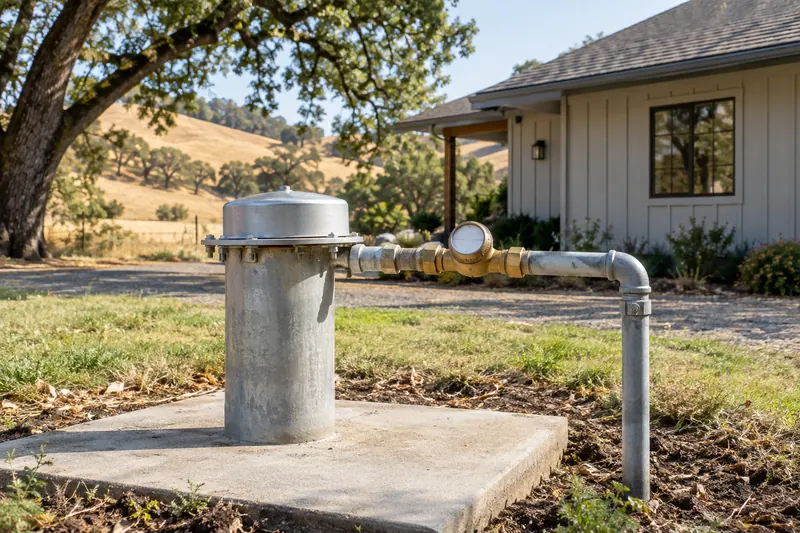
Most homes on a well in the Paso Robles basin fall under the household, or de minimis, category in state groundwater law. The groundwater authority does not charge these pumpers its fee and, under the basin plan, does not regulate them. Rural domestic use is a small share of the basin's water, about 2 percent of total consumptive use by the authority's own estimate.
What counts as a de minimis well?
The test is how much water and what it is used for. The authority's 2026 fee study, citing Water Code section 10721, defines de minimis extractors as those who extract 2 acre-feet or less a year for domestic purposes. The State Water Board phrases it the same way on its Tulare Lake subbasin page: small domestic users taking two acre-feet or less for domestic purposes only.
Two words carry the weight. "Domestic" means household use, so a well that also waters a commercial vineyard block or a crop is not in this category for that water. "Or less" means the whole draw on the well, not one tap. If you run a home and an irrigated planting off the same well, ask the authority how your parcel is classed before assuming the exemption.
What does the exemption actually cover?
It covers three things in the Paso basin, according to the authority's fee study:
- The groundwater fee. The study states that rural domestic extractors will not be charged. The fee adopted on May 27, 2026, is $22.90 per acre-foot of consumed groundwater, and it falls on other pumpers.
- Meters required by the authority. Water Code section 10725.8 exempts de minimis extractors from a groundwater agency's power to require water meters.
- Regulation by the authority. The study notes that, under the basin plan, de minimis extractors are not regulated by the authority.
Statewide, the same group is also excluded from pumping reports and state fees in basins placed on probation. That rule does not apply here; the Paso basin is not on probation. Our brief on the groundwater fee has more on how the fee works.
How much water do households use in the basin?
Very little compared with farms. The water year 2025 annual report lumps small public water systems, golf courses and rural homes into one line: 3,531 acre-feet in 2025, out of 61,400 acre-feet of total pumping. Agriculture made up 91 percent of the total. For comparison, the plan sets the basin's long-term sustainable yield at 61,100 acre-feet annually.
- All pumping in the subbasin61,400 acre-feet
- Sustainable yield in the plan61,100 acre-feet
- Small water systems, golf and rural domestic3,531 acre-feet
Source: WY2025 Annual Report
One caution goes with the 2025 total. The report says it fell because the method for estimating farm use changed, not because pumping really dropped by about 15,000 acre-feet.
What still applies to a household well?
Nearly everything else. The exemption is about basin management, not about how a well is built, permitted or kept safe.
County well permits. San Luis Obispo County Environmental Health must approve a new well before drilling starts, and a C-57 licensed driller applies on the owner's behalf. Our Wells section covers this in drilling a new well.
County meters on new buildings. This is easy to miss. The authority cannot make a household pumper install a meter, but the county is a separate body with its own land-use rules. Its basin page says that while the 1:1 water offset for new construction expired on January 1, 2022, well meters are still required for new structures. The full list of county limits is in our story on the county's rules for new wells and building.
Water quality. Nobody else tests a private well. The county says private well water is not regulated or monitored by any outside agency; the owner is responsible. See testing your well water.
Falling levels. The exemption does nothing to protect a shallow well from a dropping water table. In its 2020 comments on the first plan, the State Water Board found that 123 domestic wells in its analysis, or 17 percent, that were unaffected in 2015 would be impacted or go dry at the proposed minimum thresholds.
Does the state well-permit order apply to household wells?
Mostly not. Executive Order N-3-23, signed February 13, 2023, says local agencies in medium- and high-priority basins must get written verification from a groundwater agency before approving a new or altered well. It exempts wells that will provide less than two acre-feet a year for individual domestic users. DWR reported in March 2024 that this part was still in effect; we found no later notice either way.
Why does the household line matter for the basin's future?
Because the plan has to be paid for and carried out by someone, and household pumpers sit outside the fee. If the state ever took over the basin, the authority warns, it could impose fees and require reporting of pumping. Statewide rules under probation still exclude de minimis users from reporting and fees, but the shape of local management would change. That is one reason household owners have a stake in how the plan is funded.
When DWR approved the plan in 2023, it asked the agencies to consider how they would address drinking-water impacts while overdraft continues. For a household on a shallow well, the practical steps are to keep records of water levels, know how to report a dry well, and read what to do when a well runs low.
Where to call
- Paso Robles Area Groundwater Authority — whether your well is classed as household use, and how the fee applies to mixed home-and-farm wells. pasoroblesaga.org
- County of San Luis Obispo, Planning & Building — well meter standards for new buildings in the basin. Water Programs
- County of San Luis Obispo, Environmental Health Services — well construction and destruction permits. Well Program
Common questions
Do I have to meter my household well?
The groundwater authority cannot require it for de minimis pumpers. The county, however, still requires well meters for new structures in the basin, so a new home may need one regardless.
Will I get a groundwater fee on my property tax bill?
Not for household use alone. The authority's fee study says rural domestic extractors will not be charged; the fee goes on the tax roll for other pumpers.
My well serves the house and a small orchard. Am I still exempt?
The exemption covers domestic use of 2 acre-feet a year or less. Irrigation for a commercial crop is not domestic use, so ask the authority how your parcel is classed.
Does the exemption protect my well if levels drop?
No. It only means the authority does not charge or regulate you. Wells can still go dry, and the annual report says several did in 2025.
Sources
- Paso Robles Area Groundwater Authority — Rate and Fee Study, May 2026 — de minimis definition, no charge, meter exemption, not regulated, 2 percent share
- Paso Robles Area Groundwater Authority — FY 2026-27 Rate and Fee Study page — $22.90 per acre-foot adopted May 27, 2026
- Paso Robles Subbasin Water Year 2025 Annual Report — pumping by use, sustainable yield, 2023 DWR recommendation, dry wells
- State Water Resources Control Board — Tulare Lake Subbasin — de minimis users under probation
- County of San Luis Obispo — Paso Robles Groundwater Basin page (archived copy, June 2026) — offset expiry, well meters for new structures
- Executive Order N-3-23 — well permit verification and household exemption
- State Water Board comments on the Paso Robles Area plan, December 8, 2020 — domestic wells at risk at minimum thresholds
- County of San Luis Obispo — Private Well Owner Resources — owner responsible for well water