In the House · Story
Hard Water and the Water Heater: What Owners Can Safely Do
A water heater on hard water collects mineral scale and sediment; a 120°F setting, a free relief valve and a plumber's flush on the manual's schedule help.
By the Ranch House Water desk · Updated · 7 min read
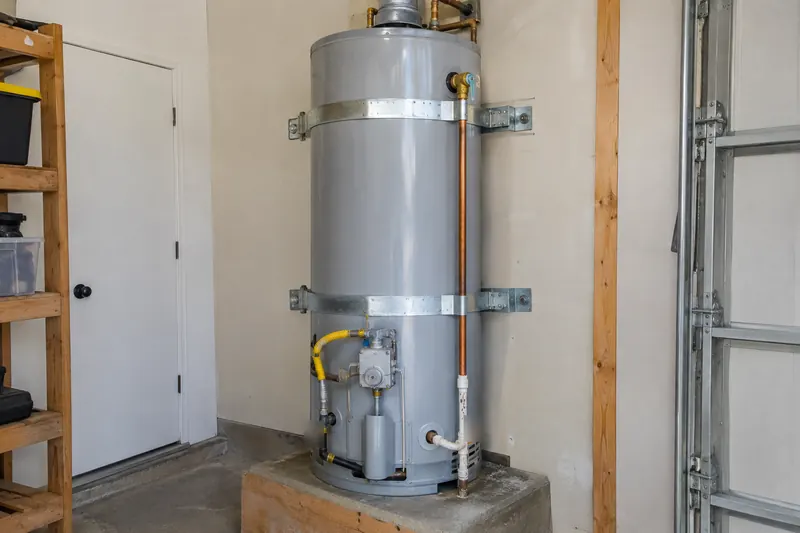
Much of the water in this part of the county is hard enough to leave a crust on a faucet in weeks, and the tank of a water heater sees the worst of it. Atascadero Mutual Water Company reported an average hardness of 20.2 grains per gallon in its 2025 water quality report, and the San Miguel Community Services District reported an average of 317 ppm in its 2025 Consumer Confidence Report. Both sit well past the line the U.S. Geological Survey draws for "very hard" water.
How hard is the water in north county?
The answer depends on where the water comes from, and on a private well only a lab test will tell you. The USGS scale calls water soft up to 60 mg/L as calcium carbonate, moderately hard from 61 to 120 mg/L, hard from 121 to 180 mg/L and very hard above 180 mg/L. San Miguel's 317 ppm (the same as mg/L) is very hard, and Atascadero's 20.2 grains per gallon works out to roughly 345 mg/L, since one grain per gallon equals 17.1 mg/L.
Hardness figures for the City of Paso Robles and for Templeton were not available to us; check the latest Consumer Confidence Report from your supplier. On a ranchette with its own well, no agency samples the water for you. SLO County says private well quality is the owner's responsibility, so hardness shows up only when you order a test. Our story on testing your well water explains how, and the brief on hard water numbers in north county gathers the local figures.
| Water | Hardness | Where the figure comes from |
|---|---|---|
| Soft | 0 to 60 mg/L | USGS |
| Moderately hard | 61 to 120 mg/L | USGS |
| Hard | 121 to 180 mg/L | USGS |
| Very hard | more than 180 mg/L | USGS |
| San Miguel CSD, average | 317 ppm | 2025 Consumer Confidence Report |
| Atascadero Mutual, average | 20.2 grains per gallon | 2025 water quality report |
What does hard water do inside a tank-type heater?
Calcium and magnesium come out of the water as it heats and settle in the bottom of the tank. The State Water Board's well owner publication links white spots on dishes and white crust around fixtures to calcium and magnesium, and lists a water softener as the usual treatment. A. O. Smith's installation and operating manual says sediment collecting in the bottom of the tank can cause "rumbling" or "percolating" sounds.
The same state publication lists a different symptom, a water heater that is corroding, as a sign of corrosive water rather than hard water. The fixes differ, so a test result comes before any equipment. What each kind of unit can and cannot remove is set out in softeners and filters for well water.
Should the heater be flushed, and how often?
Yes, on the schedule in your own heater's manual, and the job belongs to a licensed plumber. One major maker, A. O. Smith, calls for regular flushing to remove sediment and for the heater to be checked once a year by a competent service person. Intervals differ by maker; your model's manual counts.
Flushing runs scalding water out through the drain valve and, on a gas heater, means working the gas control, so this site leaves it to a licensed plumber rather than offering steps.
What temperature setting is safest?
Start at 120°F. The A. O. Smith manual calls 120°F the preferred starting point and warns that turning the dial past it raises the risk of scalding. The Consumer Product Safety Commission urges all users to set heaters at 120°F and notes that a burn can happen after 6 seconds in 140°F water or 30 seconds in 130°F water.
The Department of Energy adds that turning a heater down from 140°F to 120°F can slow build-up in your pipes. The same page says people with a compromised immune system or chronic respiratory disease may want to keep the heater at 140°F; that is a question for your doctor.
- Water at 140°F6 seconds
- Water at 130°F30 seconds
Source: CPSC
The relief valve and its pipe stay open
The temperature and pressure (T&P) relief valve is the heater's last line of defense, and it must always be free to open. The A. O. Smith manual says the valve must never be removed or plugged, its discharge opening must never be blocked or reduced, and the discharge pipe must not be exposed to freezing temperatures. The maker calls for the valve to be checked at least once a year; lifting its lever releases scalding water, so have a plumber do the check. Older-edition California Plumbing Code excerpts in a San Bernardino County handout require the drain to run to the outside of the building at no less than the size of the valve outlet.
A valve that drips now and then may be reacting to thermal expansion, the manual says. The same handout requires an expansion tank or similar device where a check valve or backflow preventer stops pressure from bleeding back down the line. A valve that keeps releasing water needs a licensed plumber; never cap or plug it while you wait.
Anode rods and a rotten-egg smell in the hot water only
If only the hot taps smell of rotten eggs, the heater itself may be the cause. Penn State Extension explains that a magnesium rod in the tank can turn sulfates in the water into hydrogen sulfide. Ask the heater's maker or a plumber which replacement rod the manual allows, and read our brief on the rotten-egg smell in water. A sulfur smell in the air of a room, away from the taps, is a different matter: treat it as gas, leave the house, and later read what to do about a propane smell.
Which jobs belong to a licensed plumber?
Installing any type of equipment to heat water falls in the C-36 plumbing classification at the Contractors State License Board. Since January 1, 2026, a person without a license may take on a job only if the total is under $1,000 and no building permit is needed. A replacement water heater must also be strapped under state law; the brief on water heater strapping covers the rule. The 2025 California Plumbing Code has been in force since January 1, 2026, so check the current code with the county.
Where to call
- Contractors State License Board — check that a plumber holds an active C-36 license before work on a heater. License Check
- Your water supplier — ask for the latest Consumer Confidence Report and its hardness figure. Atascadero Mutual water quality
- SLO County Environmental Health Services — resources for private well owners who need a water test. Private well owner resources
Common questions
Does a water softener help a water heater?
A softener is the usual treatment for the white crust that calcium and magnesium leave, according to the State Water Board's well owner publication. Have the water tested first, because a softener does nothing for corrosive water, arsenic or nitrate.
Why does my water heater rumble?
Sediment collecting in the bottom of the tank can cause rumbling or percolating sounds, A. O. Smith says. Having a plumber flush it on your manual's schedule is the usual answer.
My relief valve drips. Can I plug it?
No. The valve and its discharge pipe must never be plugged or blocked. Occasional weeping may come from thermal expansion; have a licensed plumber find the cause.
Is 120°F hot enough?
CPSC and the A. O. Smith manual both point to 120°F. The Department of Energy notes some people with weakened immune systems may want 140°F; ask your doctor.
Sources
- USGS — Hardness of Water — hardness scale
- Atascadero Mutual Water Company — Water Quality — 20.2 grains per gallon average, 2025
- San Miguel CSD — 2025 Consumer Confidence Report — 317 ppm average hardness
- State Water Board — A Guide for Private Domestic Well Owners — symptoms and treatments
- A. O. Smith — Residential Gas Water Heaters Installation and Operating Manual — flushing, 120°F, relief valve
- CPSC — Tap Water Scalds — 120°F and burn times
- U.S. Department of Energy — Renters — 120°F and the 140°F exception
- San Bernardino County — Water heater code excerpts (2020) — relief drain and expansion tank, older code edition
- Penn State Extension — Hydrogen Sulfide in Water Wells — hot-water-only odor
- CSLB — C-36 Plumbing Contractor — water heating work