In the House · Story
Plumbing in an Older Ranch House: Pipes, Valves and Permits
Old ranch house plumbing often mixes galvanized steel, copper and newer PEX; hard water and frost nights test it, and most repipes need a permit and a C-36 licensed plumber.
By the Ranch House Water desk · Updated · 6 min read
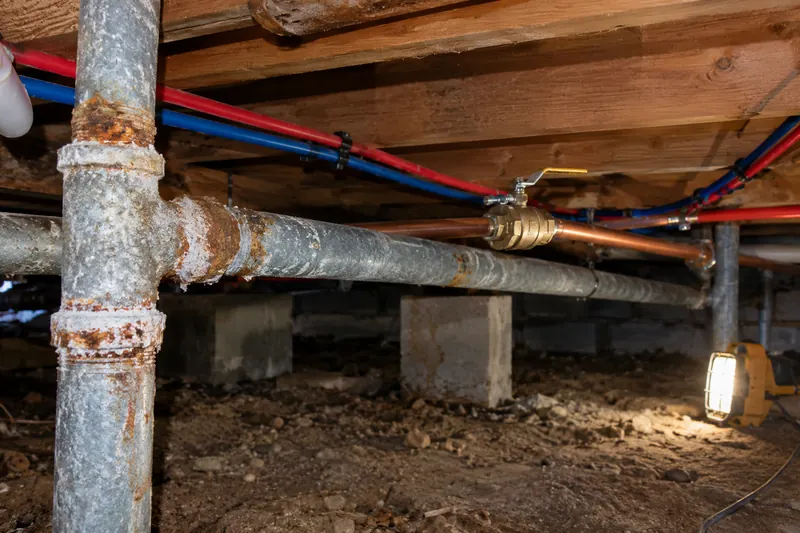
An older single-story ranch house on a few acres outside Paso Robles or Creston usually hides its plumbing in a crawlspace or an attic, close to the cold. The in-town Paso Robles weather station averages 54.3 nights a year at or below 32°F, according to NOAA's 1991-2020 normals. Add very hard water and decades of patch repairs, and an old house's pipes deserve a careful look before trouble starts.
What pipe is in an older ranch house?
Often more than one kind. Many older homes were plumbed with galvanized steel, later repaired with copper, and more recently extended with plastic PEX. A look at the pipe where it leaves the water heater, under sinks and in the crawlspace usually shows the mix: dull gray threaded pipe is galvanized steel, reddish metal joined with soldered fittings is copper, and flexible colored tubing is PEX.
Galvanized steel can rust from the inside, narrowing the pipe and lowering the flow at the taps. Where two different metals meet, joints are worth watching for corrosion. A licensed plumber can tell you what you have and whether it is worth replacing; the State Water Board's well owner publication lists replacing metal piping among the answers to corrosive water.
Does hard water matter for old pipes?
Yes. Minerals that leave white crust on fixtures also settle inside pipes, valves and the water heater. Atascadero Mutual Water Company measured 20.2 grains per gallon on average in 2025, far into the U.S. Geological Survey's very hard class. Well owners learn their own number from a lab; see testing your well water.
A cooler heater helps too: the Department of Energy credits a 120°F setting, instead of 140°F, with less build-up in household pipes. A softener is the usual treatment for hardness, but water that is corrosive needs a different answer, so test first. Our stories on water heaters and hard water and softeners and filters explain the choices.
Where are the shutoffs, and do they still work?
Find them before you need them. Most houses have a main shutoff where the supply line enters, plus small valves under sinks and toilets and one on the cold line into the water heater. On a property with its own well, the supply also passes through the pressure tank; owners may switch off the pump's breaker, but work inside the pressure switch or wiring belongs to a licensed contractor. Our story on the well pump and pressure tank covers the setup.
Old valves that have not been turned in years can stick or leak at the stem. Turn each one gently now and then so you know it still moves. If a valve will not close or starts to drip when turned, replacing it is a plumbing job.
How cold does it get under the floor?
Cold enough to freeze an exposed pipe. At the in-town station, freezing nights are most common in December, with 18.0 on average, followed by January with 14.3, November with 8.7 and February with 8.6. Pipes in an unheated crawlspace, an attic or an outside wall see those nights first. The frost nights and pipes brief covers insulating and thawing, and the rule that matters most: never thaw a pipe with an open flame.
- November8.7 nights
- December18.0 nights
- January14.3 nights
- February8.6 nights
Source: NOAA NCEI
When does a repipe need a permit and a license?
Almost always. Under Business and Professions Code §7048, as amended effective January 1, 2026, unlicensed work is allowed only on jobs below $1,000 in total that require no building permit. A repipe, a new water heater or any change that needs a permit calls for a licensed C-36 plumbing contractor, whose classification covers supplying safe water and disposing of fluid waste.
The Contractors State License Board also limits down payments to $1,000 or 10 percent of the contract price, whichever is less. The 2025 California Plumbing Code took effect January 1, 2026; ask SLO County Planning & Building which permit your job needs.
| Job | Who | Rule to know |
|---|---|---|
| Find and exercise shutoff valves | Owner | None |
| Set the water heater to 120°F | Owner | Follow the maker's manual |
| Repipe, new fixtures needing a permit | C-36 plumbing contractor | Permit from the county |
| Water heater replacement | C-36 plumbing contractor | Strapping under H&SC §19211 |
| Pump, pressure switch or well wiring | C-57 well contractor | County Environmental Health |
What about the water heater in an old house?
It needs the same checks as any other, plus a few that older installs often miss. State law requires every residential water heater to be strapped against earthquakes, and a seller must certify that it is; see water heater strapping. Plumbing code excerpts from an earlier edition, printed by San Bernardino County, call for an expansion tank where a check valve or backflow preventer traps pressure, and a relief-valve drain run to the outside. Never cap or plug that relief valve or its pipe.
What should a buyer ask about?
Ask what the pipe is made of, where the shutoffs are, and whether past work had permits. Ask for well records and the septic history too; our story on septic systems on rural lots lists what to look for.
Where to call
- Contractors State License Board — confirm a plumber's C-36 license and read the rules on contracts. License Check
- SLO County Planning & Building — which permits a repipe or water heater replacement needs. Planning & Building
- Your water supplier — the latest Consumer Confidence Report with hardness figures. Atascadero Mutual water quality
Common questions
Can I replace a leaking section of pipe myself?
Ask the county first whether the repair needs a permit. Anyone you pay who lacks a license is limited to jobs under $1,000 that need no permit; anything larger goes to a licensed C-36 plumber.
How do I know if my pipes are galvanized?
Galvanized steel is dull gray with threaded joints. Check near the water heater and under sinks, or ask a plumber to look.
Why is my water pressure low in an old house?
Rust inside galvanized pipe, mineral build-up from hard water or a failing valve are common causes. On a well, the pump and pressure tank are also suspects; a licensed contractor should check them.
Do old pipes freeze in Paso Robles?
Exposed ones can. The in-town station averages 54.3 nights a year at or below 32°F, most of them in December and January.
Sources
- NOAA NCEI — 1991-2020 normals, Paso Robles USC00046730 — freezing nights
- State Water Board — A Guide for Private Domestic Well Owners — corrosive water and piping
- Atascadero Mutual Water Company — Water Quality — 20.2 grains per gallon
- U.S. Department of Energy — Renters — 120°F and pipe build-up
- California Legislature — B&P Code §7048 — $1,000 minor-work limit
- CSLB — C-36 Plumbing Contractor — scope of plumbing work
- CSLB — home page — down payment limit
- California Building Standards Commission — Codes — 2025 code effective January 1, 2026
- San Bernardino County — Water heater code excerpts (2020) — expansion tank and relief drain